The site is always on
Pubblicato il 10/07/2025 09:22:55 | Webmaster
Although many years have passed and the graphics of the site is always the same, the results data are always updated.
...trail Orienteering

Pubblicato il 10/07/2025 09:22:55 | Webmaster
Although many years have passed and the graphics of the site is always the same, the results data are always updated.
...Pubblicato il 22/03/2023 10:43:42 | Webmaster
After some years CHIS Trophy (ex CIS) is back. It had been suspended in 2020 because of COVID with only five races run. This year, 18 competitions are on the calendar in all four organizing nations. You can find details here and at http://www.oktrzin-klub.si/sl/chis.html
...Pubblicato il 28/05/2022 20:35:06 | Webmaster
Pubblicato il 26/05/2022 18:24:24 | Webmaster
Pubblicato il 25/05/2022 08:13:55 | Webmaster
Pubblicato il 14/02/2022 10:17:07 | Webmaster
On 13th February at Golf Club of Galzignano (PD), the 2022 season has started; first round of Italy cup in Preo competition has planned by Danieli inside of the Golf club location. About 40 competitors were there included six members of Slovenia team. The winner in Open class was Emil Kacin ahead Michele Cera and Aaron Gaio; in paralympic class the best was Piergiorgio Zancanaro ahead Nicola Galvan and Maria Pajaro. Next competition is scheduled on 27th February in Marzabotto (Bologna) with 2^ and 3^ round of Italy cup.
...Pubblicato il 11/05/2021 14:09:11 | Webmaster
On Sunday, in Cansiglio's forest, there was the Italian champ in Pre-O; the course setter Renato Bettin (and Michele Cera) has planned 26 controls in a demanding terrain very similar to Slovenian forest. A good number of competitors, about 80, has fought to catch the gold medal; another good news is the number (7) of paralimpic italian competitors. The final result is a mixture of veteran trailO competitors and tempO-online new generation; infact, the winner is Marcello Lambertini, the only one without mistakes, ahead Kreso Kerestes but the silver medal is for Bettega Damiano (few experience in trailO but much more in foot-O) and the bronze medal is for Luca Stringher (few competitions in TrailO but enough experience in orienteering). In top ten, two veterans as Elvio Cereser and Danieli Daniele and newcomers as Maurizio Castellaz and Francesco Mariani. In paralimpic class, clear victory for Nicola Galvan ahead M.Bertilla Pajaro and Piergiorgio Zancanaro. Surprising to notice the 14th place for Remo Madella and the 18th for Alessio Tenani; now, the fight for a place in the national team is open...
...Pubblicato il 26/12/2020 09:31:46 | Webmaster
During these Christmas holidays, I tried the Torus trophy without the pressure of the competition. I have to say
it was a great job of finnish team and the Libor's site; infact, I think the most part of competitors hadn't ever
played about 60 stations in a month; I respected the choice to plan two different levels of difficulties.
I won't write about the standing because I don't believe some results are true:
infact, I watched the times of answer and frankly somebody is too fast ! I know the real value of Marit, Antti, Jan
and they are my benchmark to understand who is border line. Sure, about 1000 competitors is a great result.
Virtual tempO is very good to train the brain about a mental program to solve the tasks; you can decide what is the
best schedule for you: is it better to study 10" the map and then answer fast or to check directly the red circle ?
Sometimes the pictures aren't clear and the zoom didn't work well but you know the photos have the problem to twist
the perspective and some kites seemed picked in a wrong place. Another problem respect to real tempO is to identify
the features out of picture: in some controls, a building or a tree out of picture was essentials to solve the task.
Another difference between virtual and real is the situation of play: in virtual you can decide when you play, your
monitor (there were big differences to play with phone or a 24" screen) or to choose the setup of the game; in real
competitions the weather, the light, the noise, the people can interfere in your concentration or your answer.
The planners have mixed different locations in the game: many urban and park tasks but also the tipical rooks and
boulders of finnish forests and, obviously, the lakes and the snow couldn't missing.
I noticed two stations have voided: sometimes it's very difficult to plan perfect tasks despite the "zero tollerance"
has helped much the good plan of the controls.
I finish to say virtual tempO is great transmissive for the people who wants to play and to understand this discipline,
it's a perfect training for the trailO's competitors but actually the results are not fair because there are too many
factors which cause disparity.
Pubblicato il 07/12/2020 19:26:11 | Webmaster
In December, without real competitions as in all the 2020, virtual TrailO gives new exciting challenges for the competitors of the trailO's world. About 1000 people are playing in the TORUS Trophy where every day a new short competition (2-3 stations) is planned from different Finnish clubs. You can follow and play at this link. Good luck and enjoy. TORUS Trophy
...Pubblicato il 31/07/2020 12:36:07 | Webmaster
In this period some updates are on the site: CHIS trophy and Italian competitions. Waiting for ECTO...
...Pubblicato il 04/07/2020 10:07:52 | Webmaster
After the long pause due Corona virus and after many virtual competitions (I don't know if everyone competed in the same condition but it was a traning), in August the real trailO will come back in forest. Finland and double Poland will host same WRE 2020 competitions. WRE list is changed because everyone lost the results older than 18 months.
...Pubblicato il 10/06/2020 16:10:02 | Webmaster
Now, it's official: WTOC (planned in HK on November) is deleted while ETOC will remain in Finland but the date is posponed: 12 May 2021. In autumn, perhaps, there will be some competitions of ETOC but the season is without great appointments.
...Pubblicato il 14/03/2020 15:47:02 | Webmaster
Pubblicato il 11/03/2020 18:52:45 | Webmaster
Pubblicato il 11/02/2020 19:11:46 | Webmaster
The calendar of CHIS 2020 is online. Croatia continues to organize only 3 competitions, Hungary and Slovenia 5 competitions and Italy 6.
...Pubblicato il 22/06/2019 11:49:53 | Webmaster
Next week it'll begin the WTOC in Portugal. This is the official IOF trailer: "
The peak of the 2019 Trail Orienteering season is reached this weekend when the World Championships (WTOC) begin in Idanha-a-Nova in eastern central Portugal. The Open class has 89 competitors and the para class 43.
The Championships start with the Opening Ceremony on Sunday, and on Saturday and Sunday a pre-WTOC event, part of this year’s European Cup in TrailO (ECTO), is being held not far away on similar terrain. So a good warm-up occasion to back up the solid training plus competition experience that the competitors will have been doing in the past few weeks.
Star of the season so far is Juha Hiirsalmi from Finland, who has won three of the four ECTO events held up to now, and was tenth in the other one. A close runner in form is Hiirsalmi’s compatriot Petteri Halkala, 21 years old this year, who is current WTOC TempO Champion. Halkala has finished first and second in the two ECTO events he has taken part in this year. Norway is looking strong with three athletes – Martin Aarholt Waaler, Geir Myhr Øien and Lars Jacob Waaler – in the top six in the current ECTO standings. Slovenian athletes hold positions eight and nine, and a number of Swedish athletes also rank highly, the best being Erik Lundkvist. But in TrailO there are, with good reason, quite a number of nations that fancy their chances of getting a medal at WTOC.
The Championships will be held on Mediterranean terrain with mixed open, semi-open and forest, in many places with “a great variety of rock and contour detail”, as it is described in the bulletin, and with some steep slopes. The TempO Final terrain, a steep slope with many “big boulders” plus crags, spurs and re-entrants, sounds quite spectacular.
The main competition days are:
Tuesday 25th June PreO stage 1
Thursday 27th June PreO stage 2
Friday 28th June Relay
Saturday 29th June TempO Qualification and Final
Reports and leading results will be posted on this website after each day of competition. Much more detail about the venue and the competitions can be found in Bulletins 3 and 4 on the event website www.wtoc2019.fpo.pt."
In this circumstance, I want to remember a great Portughese person, for trailO growth in Portugal, who has abandoned this small world two years ago. He hadn't medals or great results in trailO but working with his photocamera and his interviews gave us a lot of news and interesting articles to discuss or simply to follow better TrailO events. Thank you Joaquim Margarido for your work: I hope you will come back to write your blog again....
Pubblicato il 03/02/2019 08:35:09 | Webmaster
Watching the calendar of 2019, I notice 17 competitions and this is a record in the young story of TrailO. Poland, Finland and Sweden are the Countries where the competitors have to come back twice! for another year Slovenia host WRE at the classic "Lipica cup" while the new entry is Japan where some European talents could compete at 14th Japan Trail Orienteering Championships. As I said, Finland has 5 WRE (FinTrailO 2019 + Fin5 2019), Poland 4 WRE (Polish TrailO Championships + Bukowa Cup), Sweden 3 WRE (PreO i Väst + Nordic match). This year will be the second step towards the normalization of the standing of WRE as more competitors could compete in 5 WRE valid for the final standing.
...Pubblicato il 19/11/2018 22:01:02 | Webmaster
Using my small camera, I maked a video during a park competition close to Milan. I tried to create a funny video with map and GPS. Here
...Pubblicato il 24/02/2018 14:54:24 | Webmaster
Starting from 2018, IOF has decided to create a World ranking standing using the WREvents and the most important competitions (WTOC - ETOC). I'm working on the site to introduce this new standing in a page but I haven't intention to manage the calculation of it. Here you can read how it works.
...Pubblicato il 04/11/2017 11:08:54 | Webmaster
As you can notice, this page isn't updated since many days, but it doesn't mean this site is dead. Infact, all the standings (WTOC, ECTO, ITOC, CIS) are updated when it's possible to do it. In next season, it will start a new ranking for all the competitors but untill now there aren't news how it will work. So, you can continue to follow this website and especially his statistics
...Pubblicato il 25/02/2017 09:16:24 | Webmaster
Next Sunday (on 26th February), Italian trailO's season will start in Sala Baganza where Susy De Pieri will plan the 1° round of Italy cup. The format is PreO and there are a good number of competitors. It's not yet clear the program of 2017 competitions but the proposals are:
Pubblicato il 11/12/2016 19:10:20 | Webmaster
This post isn't related with TrailO but I want to share this software/program with you. Virtual-O is a software (simulator) written by Peter Furucz (the younger brother among Furucz's team) and it could be an interesting strument to teach orienteering to all the newcomers. I bought and I played with it and despite this program is not finish (Peter is working on it considering the feedback of the buyers), I have to admit it's very interesting because it's realistic and accurate in all the detailes. I think this game is interesting for the guys who want to run orienteering at home but expecially for the teachers or clubs who want explain orienteering showing map and terrain to the newcomers in orienteering discipline. Here's the official site virtualo.org
...Pubblicato il 03/12/2016 21:06:12 | Webmaster
Today, after four years FISO (Italian Federation) has a new President: Tiziano Zanetello. He has a long career in foot orienteering (35 years) where he had some Italian titles and he also competed at the WOC. How will change the life of Italian TrailO? Zanetello knows TrailO, he organized some competitions in the past and he has more interest in this disclipline respect the old President. In this moment, trailO discipline, in Italy, is very close to finish the activity due the decrescent interest about it among the orienteers despite the gold medals cachted in the last years. The new board has the difficult task to rebuild this discipline in Italy; there are some ideas how to do it but often they are opposing and everybody think to have the right solution. The good news is this change coudn't be worse than the last years story when this discipline has seen like a weight and not a resource. Good luck with his work....
...Pubblicato il 26/10/2016 21:35:56 | Webmaster
Ioaquim Margarido has written a page where explain how to understand TrailO in 5 minutes..... take a look http://orienteering.org/understand-trailo-in-5-minutes/
...Pubblicato il 28/08/2016 18:15:44 | Webmaster
After 12 years the WTOC comes back in Sweden but in that occasion trailO was in the prehistory. At WTOC 2015 the big failure was Sweden because the team didn't get any medals. For this reason I waited for a big effort of Swedish team to win some medals again in this "home" championship. The type of terrain and the style of the planner had to help the competitors of Sweden and Norway instead of the continental competitors. Indeed, in tempO competition and PreO first day the athletes of Sweden and Norway had a huge advantage of knowledge and experience respect the others. Only in the last part of WTOC some guys of no-Scandinavia teams were able to learn the lesson and to bring great results. Thinking and Writing at home, I can say it was positive to follow live results on internet and it was exciting especially tempO and relay team; obviously, in the future I wait for a better service but I remember WTOC 2014 when the results arrived when Guntar was on the airplane.As usual, I like to write my personal considerations despite I wasn't in Stromstadt but I used the chat to know the news. The main problem for some competitors was the zero tollerance: some controls were not in the right place but the distance from it didn't help to understand if the controls were A or Z (this is the usual problem in every competition without Zero tollerance or without a clear explanation). This is the reason that who knew the style of the planner took advantage; however there weren't big surprises in the individual competitions and everybody knew the situation. I think the Sweden made an overall good result despite the relay open competition: in tempO took a silver medal, in PreO two gold medals, in relay para another gold... sure, Marit will think a lot of time about her mistake in relay but Slovakia was unrivalled!
Another guy to study is Martin Jullum: he arrived at WTOC in perfect shape, won the battery of tempO and in final of tempO scored his worst place ever. In PreO, he came back on the podium and in the relay made a decisive mistake.Lars Jakob Waaler and Martin Fredholm won the individual gold medals: both have a long experience in trailO but both seemed in a descend trend; this was the good occasion to come back on the top. Not good WTOC for Antti Rusanen: modest results in the individual competitions (his stripe of "better than 10th place" continues) and one mistake in relay but his tempO station in relay won the bronze medal. Not big changments in Para class: the values of competitors is the same and not new name took the medals as in team relay. Before writing about team relay Open Elite, I have to write about some new stories I watched: some competitors from Egypt, the fourth place of Iva Lovrec, the bronze medal of Janis Ruksans, the absences of Tomas Lestinsky, Jari Turto, Lauri Kontkanen and the bad results of past World champions like Vitaly Kirichenko or Guntar Mankus and the European champion Pavel Kurfurst. The most interesting competition was the new format of relay: as in all the relays everything can happen! I waited for Sweden or Norway but I wrote the possible surprises could be Slovakia and Portugal. Slovakia won the bronze medal at ETOC 2016 but in this occasion the three guys made an incredible result: all correct in PreO and only 104 seconds in tempO where Jan Furucz, after a modest WTOC, remembered he was silver medal in tempO and needed 20" to answer! The second place of Portugal, for me, wasn't a surprise: I competed in Lisbon this spring and I saw how much passion there was in that team; I want to remind you that Luis Goncalves stayed at home and Ines didn't compete well like in the last WTOC but behind them there are almost 4-5 competitors who learn fast and well. I think Joaquim Margarido will be proud of this result. And now I have to say something about Italy: I don't say anything about the exclusion of Susy De Pieri but it's strange to see the ITOC gold medal (PreO) and ITOC bronze medal (tempO) at home. I think Michele Cera had some good results in this WTOC: he catched the positions that in the past WTOC he had. Obviously, the Italian Federation hoped in another medal but not every year the lucky arrived in Italy. The same words about Martin Jullum I can write about Remo Madella: often, he arrives at WTOC with great results but he never was able to arrive at the podium. At ETOC 2016 he made a good performance and at WTOC 2016 in tempO he took his best result (5th) but PreO was his worst result in the last years; in relay, he made all correct in PreO but in tempO made a bad score. Alessio Tenani was 2nd in battery of TempO but his good results stopped there: modest results in PreO and tempO and in the relay one mistake in PreO and two in tempO. For this reasons the relay team stayed out of long podium after the happiness of ETOC. The fourth competitor was Renato Bettin: in tempO, he's too slow and it was obvious he stayed out the final; in PreO, he made a bad result in the first day but finally, in the second day, he took the 7th place. The paralimpyc team is trying to learn the secrets of trailO and sometimes one of this guys is able to make a good result; in this occasion Piergiorgio Zancanaro took the 9th place in PreO 2 and he finished at 19th place in overall standing: it was the best result of an Italian paralimpyc competitor! Unfortunately, the relay didn't bring good news but the situation is better than in the past. Let's continue to follow trailo.it on FB or twitter.
...Pubblicato il 29/05/2016 22:04:05 | Webmaster
Last post on trailo.it was about WTOC 2015 in Croatia and in this period I used only twitter message and FB account to write news but the updates of the standings continued to work. In this period the blog of Joaquim Margarido (http://portugueseorienteeringblog.blogspot.com) has continued to work very well inform us about a lot of news. The past week the trailO's world was in Czech Republic (Jesenik) for the ETOC competitions; in this occasion the team relay officially substituted the team competition. The format was: three competitors for team, some controls of PreO (60" penalty for mistake) and some stations of tempO (30" penalty for mistake to add at the time spent to answer). It works well and this experiment could continue in the future because the competitors evaluated good this format. I don't write anything about the standing (you can find the results on the INTERNATIONAL page) but I want to consider some details; the experiment of the live results didn't work well, at the beginning, but slowly the organizers have worked on it and the last days it was more clear and real. I hope this experiment will continue in the future because I used it from my house and it deserved me. About the results, I think there are top and bottom: among the top I consider the Sweden's results, after the bad WTOC 2015, the Italian medal and some good results in top 10 of Italians, the double silver medal of Martin Jullum, the gold medal of Pavel Kurfurst; behind these obvious names there are some competitors who hadn't win a medal but I highlighted in my agenda: the results of Zdenko, Remo, Kreso, Zoltan and other "old guard" aren't a surprise for me but the standing of Stankevic, Bromley Gardner, Daehli Sigur, Valente, Locker Daniel told me there are somebody else who could be protagonist in the future. My personal surprise was Stig Gerdtman: I thought he lost his skills because in the last period his results were worste than in the past and in the last ECTO's PreO was 70th ! but after two very different terrains (first preO was white map with contours while the second was yellow and a lot of cliff and boulders) he was the best. Among the bottom I have to put the young generation of tempO: Marit, Pinja, Lauri, Sondre were my favorites for tempO medals (without Antti) while Eric, Lennart (both in good shape during the ECTO), Martin Fredholm, Vitaly and Guntars were expected for PreO medals; in general, Finland was a failure. I listened to an old type of planning: zero controls ambiguous with zero tollerance! I cann't say about it but I believe the time of Zero tight have to finish because we have a lot of place where we can plan a good competition without unfair controls.
...Pubblicato il 28/11/2015 22:37:08 | Webmaster
In this period it's expiring the subscription of the website. I haven't problems to pay it (about 30 euro) but I'm asking myself if this site needs to somebody or not... In these mounths my job is becoming heavy and I have less time than in the past to update the standing or to follow trailO. In Italy, despite we have the world champion this discipline is disappering and my site didn't help to grow the appeal of it. Now, is it the time to finish this experience? I think to continue in 2016 but next year I will redo this reflection and perhaps my decision will be different...
...Pubblicato il 28/06/2015 08:09:51 | Webmaster
Second leg in PreO and situation completely different from the first day: hot, sunny, open areas small detailes and all the track was on the grass of the Golf Club making happy the paralimpyc competitors. Different skills respect the first day and almost ten people with full score. It was obvious the real difference among the competitors has made the first day. Infact, in Open class the veterans of PreO pushed hard and Antti won the second day ahead Marko Mattaala, Stig Gerdman, Christian Gieseler, Martin Jullum, Vitaly Kyrychenko, Sergi stoian and Michele Cera (all competitors without mistakes) who saved the point of advange took after first day. The gold medal was for him ahead Antti Rusanen and Martin Jullum; Marko Mattaala, Vitaly Kyrychenko and Guntars Mankus completed the long podium in Open class. In Paralimpyc class, Ivica Bertol and Vladimir Vovk made all correct ahead Michael Johansson and Jana kostova (one mistake) but the World champion was Vladimir ahead Ivica and Saxtorph Soren, out of podium the Swedish Ola Jansson, Michael Johansson and Jana Kostova. In the team class, Ukrain took the gold medal ahead Croatia and Finland. After tempO competition, I wrote something about the new generation.... it's clear the PreO competition needs the skill of experience and in the second day we have seen to come back the "old lion" of PreO. I want underline Sweden doen't bring at home any medals and this situation never happened in the past; next year the World championship will in Sweden and they could be come back on the podium.
...Pubblicato il 27/06/2015 07:06:59 | Webmaster
As I wrote yesterday it's clear the World of trailo is changing; it's impressive to see the first Swedish at 10th place! the terrain of the final was a wide open area (a golf area) where micro hills, knolls, pits, small and large bushes made the map very tricky. I think you cann't arrive here and to think about the victory using only your skills but I have to train your brain to recognize these small map's detailes. The 7 stations (with 5 controls each one) were very difficult and the perfect work of "miss umbrellas" made more difficult to study the terrain before to arrive at the stations. Great idea to show the last two stations publicly and to watch "live" the answers of the competitors; it was a pity the webcamera didn't work well otherwise the internet trailo's fan could follow at home these last two stations; but, I think, this the future of tempO. We have the future of tempO watching the standing: only the "computer" Antti Rusanen was able to defeat the new generation of trailorienters: they are the Slovakian Jan Furucz (in CIS trophy you can see his yearly results) and the young Norwegian Sondre Ruud Braten who took away the bronze medal from the neck of his teammate Lars Jakob Waaler. Behind them four newcomers: Lauri Makinen, young guy from Finland (he has good masters), and expecially the Portuguese duo Luis Goncalves and Ines Domingues (remember this name... I think she can arrive at the level of Marit and Pinja) and the Italian Alessio Tenani who arrived directly from foot-O. And the "great" veterans? Tomas Lestinsky was 9th, Martin Fredholm was 10th, Martin Jullum was 12th and Marit Wiksell 21st. About the young guys, I want highlight the best Croatian is Iva Lovrec at 22nd place and Oleksii Kyrychenko at 29th (he's very fast but not so accurate). Today we have the second part of PreO and the leader is Michele Cera who starts with one point better than the followers. Stay tuned on https://www.facebook.com/wtoc2015 to know the news live....
Pubblicato il 25/06/2015 21:16:19 | Webmaster
I remember, some years ago, the Scandinavian Countries placed their competitors in the top 15 and the other competitors tried to reach some good results among these masters. Today, tempO qualification has shown that period is ending: infact, we have always some Scandinavian guys in the 36 finalists but I have seen a lot of new names and Countries. In the top 3 positions we have Czech R. , Norway and Finland but if Tomas Lestinsky and Antti Rusanen are old glory of trailo, the name of Norwegian Sondre Ruud Braten is a small surprise. In the top 10, we have a mix of newcomers and veterans: three Swedish (Wahlgren, Fredholm, Wiksell) are the veterans while Oleksii Kyrychenko (UKR), Alessio Tenani (ITA), Edgar Domiguez (POR) and Jan Furucz (SLO) are new names in the elite of trailO. But, the surprise aren't finished here: Portugal placed other two finalist (Ines Domiguez 20° and Luis Goncalves 25°), Spain one finalist (Antonio Hernandez 17°), Slovenia two finalist (Emil Kacin 11° and Kreso Kerestes 21°) Ukraine other two names (Hoienko 18° and Vitaly K.34°). I want to remember the Russian Dokuchaev 22° place and the only one paralimpyc in final; the last mention for Iva Lovrec who was able to take the final at her first experience. Among the excluded there are some names very important: the Swedish Erik Stalnacke, the Italian Remo Madella, the German Anne Straube, the Lithanian Guntars Mankus and the Croatins Ivica Bertol and Tomislav Varnica. I'm a little sad for the young Danish Johanne Biering very close to the qualification. Tomorrow, in the Golf resort of Zagreb, we will see who will win the first gold medal.
...Pubblicato il 24/06/2015 20:25:12 | Webmaster
It was a pity: the rain felt before and during the competition has ruined the competition expecially for the paralimpyc competitors because the path has become like a strip of mud and all was difficult. There were 26 controls divided in two parts; the terrain was a forest flat in the central part (with a lot of bends of a creek) and not steep slope hills at the edge of the map. The skills to take a good score were the estimate of distance, good interpretation of contour lines and a good sight to check the right bends of the stream. The result says there isn't the Scandinavian domination: infact, the leader is the Italian guy Michele Cera with one mistake together the Latvian Janis Ruksans while with two mistakes there are the "great" Antti Rusanen ahead the allways more surprising Dusan Furucz, the 2014's World Champion Guntars Mankus, the first Swedish Martin Fredholm, the "evergreen" Anne Straube, and the TempO's Champion Martin Jullum. Bad day for Ivo Tisljiar, Kreso Kerestes, Tomas Lestinsky, Remo Madella, Jan Furucz, competitors who could be in top 10. In paralimpyc class, the leader is Ola Jansson with only two mistakes ahead Soren Saxtorp and Vladislav Vodk with three mistakes. The second day will be on Saturday and for two days Italy can dream like Elvio Cereser last year. Tomorrow, it will be the tempO qualification.
...Pubblicato il 17/06/2015 14:37:33 | Webmaster
By now the time to prepare the WTOC is ending; next week the WTOC 2015 will start and all the fans of the trailO will watch the competitions which give the medals. But, before this appointment there will be an important pre-WTOC: three days in Varazdin (Croatia)! at the beginning, the organizers believed to plan a competition for the usual group of CIS competitors, now they have more competitors than the WTOC ! there will be 1 tempO and 2 PreO competitions. The results will be valid for CIS trophy (1-2 stage) and ECTO (2-3 stage). After this event everybody will look at Zagreb where 27 Countries will have almost one competitor (Egypt, Bulgaria, Turkey are the newcomers). TrailO.it will be present and the target is to arrange a live with webcam and streaming to tell what is happening there. Stay tuned...
...Pubblicato il 08/06/2015 13:48:09 | Webmaster
On Sunday, in Levico (on the same terrain of tempo's final WTOC 2014) there was the italian championship of TempO. The planner was Renato Bettin ( the same of WTOC) and more than 15 competitors were there to win the title. Absent, the current champion (Alessio Tenani), while the other competitors were the best of Italian movement. It seems the competition was fair and appreciated; the winner was Susy De Pieri (198" and no mistakes) ahead Remo Madella (245" and one mistake) and third place for Alberto Grilli (354" and 3 mistakes). Fourth place for Michele Cera who will rappresent Italy at the next WTOC in tempO discipline together Madella and Tenani. This competition was valid for CIS trophy, too.
...Pubblicato il 11/05/2015 16:21:06 | Webmaster
In Monte Livata (Rome), the past week end there was one of the most important italian competition: Italian championship of PreO. The terrain was beatifull because open areas, forests and contour lines gave a right place were compete in PreO. Unlucky, the map (enlarged scale from the original 1:15000) and the low experience of the planners made a "strange" competition were the most important skill was to understand the mind of the setter instead to think about the map/terrain; infact, the standings were very different between two days. The best was Renato Bettin (winner at ITOC 2014 with 5 competitors) and this time, he can be satisfied because there were all the best italian competitors; the second place was for Alessio Tenani (big recover in the second day) and third place was for Remo Madella who had the same score of Elvio Cereser and Fulvio Lenarduzzi. In paralimpyc class, we had, finally, three competitors and the the best was Fabio Bortolami. Standing here
...Pubblicato il 20/04/2015 16:00:32 | Webmaster
Two competitions, in Italy, were during the past weekend: tempO in Martellago and PreO in Padova; both competitions were valid fot CIS trophy and Italy cup.
Renato Bettin planned the tempO competition as usual (check WTOC 2014): 8 stations with 4 controls. The best players made 6-7 mistakes and their time was over 30"; this was the occasion for Ivo Tisljiar (usually he uses the lens and his speed is brake), who won ahead Remo Madella, Michele Cera, Alessio Tenani and Susy De Pieri.
Sunday, Daniele Danieli planned a PreO competition in a classic urban park were "between" was the most used rule. As in 2014, the best two were Michele Cera (full score) and Elvio Cereser (one mistake) like Kreso Kerestes, Marco Giovannini and Ivo Tisljiar (everybody with one mistake). Italy cup is almost decided because it remains only one competition in 2015. Next step of CIS trophy is next Sunday in Zagreb (Croatian championship).
Pubblicato il 09/03/2015 14:41:40 | Webmaster
The past weekend the Cro-Ita-Slo trophy (CIS) began in Povir (Slovenia) during the classic Lipica Open (foot-O and trailO competitions); Ok Trzin was the club organizer and Kreso Kerestes was the planner of PreO (Saturday) and tempO (Sunday).
All the controls (both competitions) were on the same map and the terrain was a karst forest very tricky and interesting; finally, there aren't complains because Kreso used 3 meters tollerance and he scattered the flags far from the path and competitors had to use remapping and good view to understand the controls. Two competitors seemed at ease with this terrain: Marco Giovannini and Dusan Furucz ! in preO competition both made full score but time control made the difference (a lot of competitors mistaked the first time control) to advantage Marco. Nine people made one mistake and the faster was Elvio Cereser ahead Susy De Pieri and Jan Furucz; 27 people were classified from 6 Countries. TempO competition had 7 stations and 5 task for each one; in this competition it was important don't made mistakes and take the right time to answer well. Infact, the winner, Marco, wasn't the faster but he had only 3 mistakes (351 score) while Dusan made 6 mistakes (401) and Zoltan Mihaczi made 7 mistakes (409); fourth place for Alessio Tenani (448) ahead Susy De Pieri (478) and Fruszina Biro (488 and 4 mistakes). The final standing of two days was Marco Giovannini (200 points) ahead Dusan Furucz (195,76), Susy De Pieri (188,09), Alessio Tenani (188,05) and Jan Furucz (186,60). Page of competition
Pubblicato il 25/02/2015 10:02:52 | Webmaster
Despite the crisis, it seems we have some competitions in Italy in 2015:
Saturday, 18 April, 2015 Martellago (VE) Pre O Coppa Italia
Sunday, 19 April, 2015 Padova Pre O Coppa Italia
...
Pubblicato il 01/12/2014 09:48:28 | Webmaster
This weekend, near Zagreb, there was the last lap of the long run of Cro-Ita-Slo (16 competitions) organized by OK Orion; two were the competitions (1 PreO and 1 Tempo). Seven people made full score in PreO (after two complains) but two were the winners: Jan Furucz and Michele Cera ahead Tomislav Varnica, Kreso Kerestes, Zdenko Horjan, Renato Bettin and Ivica Bertol. In tempO's competition Remo Madella had his revenge (10th place in day one) and he won clearly ahead Ivica Bertol and Dusan Furucz. The winner of Feuda cup was Ivica Bertol ahead Kreso Kerestes and Remo Madella; Remo wins the CIS trophy ahead Michele Cera and Tomislav Varnica.
...Pubblicato il 17/11/2014 21:03:28 | Webmaster
Yesterday, in Alzate brianza, there was the last round of Italy cup; it was tempO formula and only fourteen people were at the start. It seems a bad period for TrailO in Italy: few competitors and lacking interest to grow the visibility among the people. But, coming at the competition, Remo Madella won the last round ahead Alberto Grilli and Elvio Cereser; the competition wasn't the best for tempO since the terrain and some stations weren't adequate for tempO. Cera wins the Italy cup ahead Pfister and DePieri (Elite class), Bortolami ahead Nardo and Da Re (Paralimpyc), Cus Parma ahead Asd Padova and Swallows Noale (team class). On last weekend of November, in Zagreb, it will be the last two rounds of CIS trophy.
...Pubblicato il 19/10/2014 09:25:09 | Webmaster
In this period there are two new ideas for trailo and foot-O games online.
On http://www.ocoach.se you can try to win some competitions with your club; you have to train your atlethes and compete vs many others clubs. Pay attention to your money, your transfert market and some other things that a manager have to know.
Lauri has written on FB this message:
Me and Martin F. have created mobile answering platform for preo competitions. It means that in future competitors can answer with their mobile phones. This is possible already and I have already made the first test competition.
What?
Photo-preo with Google street view, photos and sprint map 1:4000. 10 A-flag tasks. I made this course today. This training is open until next Tuesday.
Entries?
To my email laarkont@gmail.com .(I need you first name and last name). Within 12h you get login name and password from me so you can answer yourself on preoresultat.se. I hope that you could punch/answer with phone or tablet. If you don't have such, then you can use computer. You can use computer on watching pictures, street view and maps.
How?
Make entry to my email and you'll get login and password to this page http://preoresultat.se/input/index.php and link to map and photos. . You have to use Google street view to get all correct. More information on the link's webpage which I give after your entry. Link to start place https://www.google.fi/…/data=!3m4!1e1!3m2!1sEURV7pGAbOWofQi…
Why?
I have planned to have online preo-final in Finnish Champs 2015 (held in 22-23 of August in Kontiolahti). In final competitors have mobile phones and they answer after each control by their phones. Results comes online in few seconds. Spectators are behind and they know the results all the time.
NOW, I CAN TRY THIS NEW IDEA.
...
Pubblicato il 28/09/2014 17:01:29 | Webmaster
Second competition in Zagreb, today, but the result is similar like yesterday: Remo Madella wins again ahead the Japanese Chino Koji (both have full score) and third place to Kreso Kerestes. A lot of people make one or two mistakes and the standing is very close. Two complains were reject (both controls maked the difference in the standing) although one of them was very close at the limit of tollerance (I suggest to the planner to avoid similar control at the next WTOC). The competition was inside a park and the aligments helped to solve a lot of tasks but in this case it's important to find the right features because the map wasn't perfect. The organization was good and I think they are ready for the WTOC 2015. Just to say you: Michele Cera made all right but he lost 1 point due 5" extratime! This mistake could cost the gold medal in CIS trophy...
...Pubblicato il 27/09/2014 21:34:38 | Webmaster
This weekend, in Zagreb, there are two competitions (tempO and PreO) as Pre-Wtoc 2015 and new rounds of CIS Trophy. The organizer club (OK Vihor) is testing the procedures and the tasks for next WTOC. A good numbers of competitors are there from different Countries (just from Japan). Today, it was tempO time: 32 controls in 8 stations spare in a lovely place among meadows and lakes (very close to the place of WTOC 2015). The tasks were a good mix between easy and hard difficult: the right time to answer was 20/30 seconds and 6 mistakes were the best score. One complain (accepted... 2 meters out of tollerance, in a task more than 100 meter far) and a very close standing; Remo Madella won ahead Kreso Kerestes, Jan Furucz, Marco Giovannini and Zoltan Mihalczi. Tomorrow, the PreO competition in center of Zagreb: here results and photos (on FB....https://www.facebook.com/wtoc2015?fref=ts)
...Pubblicato il 18/08/2014 13:05:50 | Webmaster
I want to invite you to read the interview by Joaquim Margarido to Lauri Kontkanen about the past and the next WTOC. Here
...Pubblicato il 14/08/2014 10:34:48 | Webmaster
I have added a function to search the international competitors in my database. You can insert a surname, name or nation (or part of them) to find a result. A new window will appear and you can choose the competitor among other results. Click on the "green dots" to open the personal schedule. If you don't see the photo, the reason is I haven't found it on internet; write to me where I can find it....
...Pubblicato il 28/07/2014 11:04:30 | Webmaster
In the past week, some trailO's competitions took part; among these meetings there were rounds of Croatia - Italy - Slovenia trophy. Good results for the new champions of Croatia team ahead some of the best Italian competitiors. But the good news, for this trophy, is a webpage that I dedicated to it in this website. Unlucky, since 2013 the old site doesn't work and many competitors have lost interest about it because nobody updated the results and the manifestations. I don't want to take this task for me but I want to help the organizers to manage this trophy better than now. So, you can find a label (on the top of the page) where you can follow this trophy. Sure, they could be some mistakes (I have a lot of trailo's work in this period) and I invite you to write me at contact@trailo.it to suggest or to inform me about them.
...Pubblicato il 25/07/2014 10:14:05 | Webmaster
During this week, at Oringen manifestation (Sweden), there were two rounds of ECTO trophy; both competitions had the same winner: Martin Jullum! so, now they remain only the rounds in Danmark and Czech Repubblic and few competitors can beat him in overall standing. After the second place in ECTO 2013, Martin is very close to take the victory in this unofficial trophy after the gold medal at WTOC 2014 in tempO discipline. In these last months we have known some new names like Furucz, Ruud Braten, Tingstrom, Boqvist…. I hope the world of TrailO will continue to find new good competitors to upgrade the quality of the competitors.
I want to inform you, there are some new PreO games: I want to thank Kreso and Nuno for their collaboration in this work.
Pubblicato il 16/07/2014 20:25:28 | Webmaster
News for competitors of Cro - Ita - Slo trophy 2014: here you can see the standings after 7 competitions! I have used new calculation rules; I remember you the total number of competitions is 17 but the every competitor can use the top 6 score and maximum 3 for each Country. Green color for Italian competition, pink color for Croatia, blue color for Slovenia; in a column there is the sum of all results and in the last column the top 6 results.
...Pubblicato il 13/07/2014 12:29:46 | Webmaster
Now, WTOC 2014 is over and you by now know who are the winners. I would make a comment but here you can read an excellent post by Margarido and I'm agree with him. I can add some words about the rumors I read on internet and I listened to the competitors: the WTOC's team had some problems about the time program because it was too slow and the competitors had to wait for start, news, results giving an idea of disorganization. The competition was fair, in the second day, but 2-3 decisive controls were Z tollerance not clear. I didn't listen to good comments about first day especially in the second map controls; the time controls were too difficult respect to their value with these new rules (TC is used to split the same score and not to add new points). I wrote, one year ago, "everybody can win WTOC 2014" because I knew the style of italian planners: infact, Guntar (in my personal ranking he's in the second group) hasn't great results despite he competed in several past WTOCs. The negative surprise was Finland: only Lauri K. took a silver medal (a lot of protests about third station in tempO)! The champion 2013, Jari Turto, was 22nd and Antti made his worst result (10th) respect all his past WTOCs competitions. Out of top 10, Martin Fredholm (11th) silver medal in Vuokatti, Martin Jullum (13th), Waaler LJ, Lestinsky .... but we had new entry like M. Maattala, Maria Krog Schulz, J. Furucz. Italian team, after the thrill of first PreO day (Cereser in top place) took the usual line: in Finland, Guido Michelotti (7th) and Remo Madella (22nd) Marco Giovannini (40th) were like Michele Cera (12th), Elvio Cereser (16th), Valerio Pfister (43rd). I want to support Fabio Bortolami because he started this year to play trailO and he is improving very good; I hope he doesn't stop his efforts to learn this discipline! Next year the WTOC will be in Croatia and they have gained the gold medal in team class....
...Pubblicato il 11/07/2014 21:55:57 | Webmaster
Unlucky, untill now, we haven't the official results; so, I can write this post using rumors and news from friends. Open Elite: Guntar Mankus (LAT) won the title ahead Marit Wiksell (SWE) and bronze medal Geir Oien (NOR) then Kirychenko (UKR), M.Mattala (FIN), Horjan (CRO); best italians were Michele Cera 12th and Elvio cereser 16th. Paralimpyc class: M.Johansson (SWE), Ola Jansson (SWE), J. Crosby (UK). Team class: Croatia, Sweden, Latvia. After the results we can tell something about the competition but the true is that after 10 hours the media don't know the complete results.
...Pubblicato il 09/07/2014 21:00:01 | Webmaster
Not good day for PreO at WTOC 2014 - first round: at the beginning the competition had 19 controls but a storm had overflowing the terrain of the last map. So, the competition was reduced to 12 controls; the start was at 10 a.m. but the final standing was at 7 p.m. During these hours all competitors were busy to answer controls, to travel with bus, to stop and to restart they competition. At the end, one control was voided and many competitors didn't like the second time control. Now, we have the results: in open Elite there are 8 people with full score but everybody has mistaked the time control! the leader is Elvio Cereser (74" - Italy), Dusan Furucz (75" - Slovakia), Koiji Chino (79" - Japan), Guntar Mankus (84" - Latvia), Kreso Kerestes (90" - Slovenia), Sharon Crawford (101" - USA), Aleksei Laisev (103" - Estonia), Marit Wiksell (144" - Sweden). Behind them 23 people with one mistake but a lot of them have good score in time controls; three competitors made full score (and good time controls) but they went out of time limit. In this group there are many "big names" like Rusanen, Makinen, Fredholm, Jullum, Lestinsky while world champion of 2013 (Jari Turto) has 9 points. Others two Italians (Cera and Pfister) are 32nd and 33rd with 9 points and 11" and 15". This leadership, for Elvio, is dangerous because pressure will grow hugely inasmuch Italy has never won medals in Elite class (Falda won in Para class and Guido M. was 2nd in tempO trophy). In Para class, Sweden leads with Michael Johansson and Inga Gunnarsson ahead Kari Pinola (Finland). Standing
...Pubblicato il 07/07/2014 19:53:39 | Webmaster
Finally, after Antti in Portugal, another terrible guy has won the gold medal; Martin is one of the best in the world but untill now he wasn't able to catch the gold medal. After the first round he was second behind Antti and his distance was more than 60 seconds; but, the second round was terrible and the competitors changed their positions very easily. The new champion wasn't the best in the final match but Antti made worse than the Norwegian and he went out of the podium. The coach of Finland (in tempO), Lauri Kontkanen got a great second round and he took the silver medal ahead the world champion 2013 Pinja Makinen who adds the bronze medal to her collection. Fourth place for Antti Rusanen ahead the first Swedish Marit Wiksell who tried a recovery like in Finland 2013 but this time hasn't gone good. Great second round for the Japanese Yamagushi who made the second best score! Out of the top Martin Fredholm (4th in the first round) while Tomas Lestinsky continues his collection of good results in top 10. The best Italian was Michele Cera (17th); a good result but Italian team without Guido M., Remo M.,Susy De Pieri and Marco G. is a bit penalized compared with last editions. On Wednesday the first round of PreO in Lavarone.
...Pubblicato il 07/07/2014 13:40:36 | Webmaster
After the qualification the Nordic teams have played their cards and nothing remains to others; Antti (231) leads ahead Martin J (299) and Pinja M. (309). Behind them Martin F., Marit W., Lauri K., Thomas L. and two Furucz. For Italian team only Michele Cera (18th place) is in the final (he was the only one who could do it). The last one in the final is Kreso K.; big results for Antonio Hernandez and Luis Goncalves. The final will be in Levico in the afternoon.
...Pubblicato il 04/07/2014 17:44:47 | Webmaster
Next week it will start the WTOC 2014 in Italy; the first competition is tempO discipline on Monday in Alberè di Tenna and Levico Terme. The planner is Renato Bettin and the final is for the best 24 competitors of semifinal.... You can follow it on line here. Some problems to find the results of 6th round of ECTO: in next days there will be the update of all the old competitions (Italy cup and ECTO)
...Pubblicato il 29/06/2014 21:46:25 | Webmaster
Second day in Cansiglio forest, today, for PreO competitors; Renato Bettin (planner of tempO competition at WTOC 2014) has planned 20 controls (and 2 TC) in 75' minutes. The terrain and the map were the same of yesterday but the type of controls were different: today, the good strategy was remapping the forest because the flags were quite far from the main path and Z tollerance was quite clear. Some imprecisions in the old map have created some mistakes but it was important to understand the type of planning. The surprise were the East European competitors: in the first day Furucz Dusan (SLK) was 12th and Mihaczi Zoltan (HUN) was 9th while today they took the first and second place with 18 and 17 points! Third place for Michele Cera (17 pt. And 9") fourth for Ivana Gobec (17 pt. And 22"); behind them the only two with 16 points Marco Giovannini (6") and Damir Gobec (12"). Next appointment will be at WTOC because Pre-O meeting in Slovenia is deleted.
...Pubblicato il 28/06/2014 21:34:03 | Webmaster
Today, new round of Italy cup and Cro - Ita - Slo trophy; the location was Cansiglio forest (during Alpe Adria competition of foot-O) on the similar terrain of WTOC. Elvio Cereser planned 20 controls (and 2 TC) on an old map of foot-O; as usual when the competitions are with old map revised there are difficulties to understand the right distances and colors. Nevertheless the competition was good and the mistakes were different among the competitors. The winner, with only one mistake, was Valerio Pfister ahead Ivana Gobec (Cro) with 2 mistakes; behind them were some competitors with three mistakes: the faster in TC was Marco Giovannini (Slo) then Michele Cera, Damir Gobec, Kreso Kerestes and others. Good number of competitors after the failing experience of last ITOC. Tomorrow, on the same type of terrain will be the sixth round of Italy cup.
...Pubblicato il 15/06/2014 17:20:48 | Webmaster
Few news from Puglia where ITOC 2014 was played; Renato Bettin (36 pt.) is the new Italian champion ahead Susy De Piery (35 pt.) and Elvio Cereser (34 pt.). Valerio Pfister (30 pt.) and Alberto Grilli (29 pt.) are the others competitors in Open Elite while Mauro Nardo has beaten Francesco Valentini in Paralimpyc class. I think Renato deserved this title because he's a good player but I don't believe he can be happy to win this crown against 4 competitors. I believe next competition in Cansiglio can become a real Italian championship but Elvio and Renato are planners and they won't compete for the victory. Next meeting is ECTO in Lithuania and Latvia while in Italy we will have Italy cup (and Cro-Ita-Slo trophy) on 28th June.
...Pubblicato il 14/06/2014 08:21:45 | Webmaster
This weekend, there will be the 5th Italian championship of PreO; few news from Puglia but it seems there are only 5 competitors in Open Elite. Perhaps, somebody else will be at the start but this edition will be remember like the bottom of competitors... Why? the Federation has decided to give the organization of this championship to a club very far from the usual locations of TrailO; so, the most part of competitors has decided to stay at home instead to travel in Puglia to compete at this ITOC. Last meeting, in Asiago, we had about 50 people..... Unlucky, the website of competition doesn't work!
...Pubblicato il 01/06/2014 22:25:53 | Webmaster
New round of Italy cup today in Asiago; among the competitions of "3 day of trenches" there was a PreO match for new and old competitors. More than 40 people were at the start of this edition dedicated to "A.Lunardon"; 21 controls planned by Remo Madella and Michele Cera spared on the meadows near Asiago. The controls seemed easy but nobody was to able to avoid mistakes. So, the winner Alessio Tenani (foot - orienter of national team) won the competition with one mistake; Alessio isn't newcomer because in the past years he competed very well in PreO discipline. Behind him, a group of 7 people with two mistakes: the faster in time controls was Kreso Kerestes (10") ahead Renato Bettin (21") Lenarduzzi (22") and the surprise of day Marcello Lambertini (23"). Not excellent results for E:Cereser (10°), Raus (12°), Danieli (14°), Pfister (15°) after their good ETOC competitions. Next appointment is ITOC on 14th June in Puglia.
...Pubblicato il 11/05/2014 17:27:55 | Webmaster
Second day, another day. Yesterday, in tempO discipline, Finland took all the podium; today, in PreO version, Norway and Sweden had their revenge. 13 people without mistakes but the faster in time control was Martin Jullum ahead Marit Wiksell while the third place was for Martin Fredholm and Geir Kyhr Oien. Incredible the high level of the competitors: 31 people with max one error. Bad positions for Jari Turto (32nd) and Pinja Makinen (47th)! Marit W. won the FintrailO 2014 edition ahead Martin Jullum and Martin Fredholm. Next ETOC appointment is on June in Latvia and Lithuania.
...Pubblicato il 10/05/2014 22:19:29 | Webmaster
Today, it started the first round of ETOC 2014 in Finland; tempO discipline was the scored standing. Finland took all the podium: Pinja Makinen (132") took the first place ahead Lauri Kontkanen (160") and Antti Rusanen (164"). Out of podium the winner of ETOC 2013 Lars Jako Waaler and Marit Wiksell. Not bad surprise for the best competitors like Martin Jullum (7th), Jari Turto (8th), Martin Fredholm (11th); a good number of competitors (82) but nobody from Italy. Tomorrow, the second round in PreO discipline....
Pubblicato il 03/05/2014 09:25:55 | Webmaster
Next weekend (on 10-11 th of May), there is the open of new edition of ETOC; there will be the first and the second round in Finland near Helsinki. Both tempO and Preo will be played; this is the first international competition after ETOC where Finland has taken three gold. Last edition has been won by Lars Jakob Waaler ahead Martin Jullum and William Rex (here). You can follow this competition here
...Pubblicato il 16/04/2014 10:49:06 | Webmaster
I have updated the international result with ETOC 2014. Here the official site with detailed answers.
...Pubblicato il 15/04/2014 22:35:56 | Webmaster
I'm waiting for official results but the rumors say:
PREO - Elite: 1. Jari Turto, 2. Antti Rusanen, 3. Marit Wiksell, 4. Stig Gerdtman, 5. Martin Jullum, 6. Pinja Makinen, 7. Elvio Cereser, 9. Remo Madella; Paralimpyc class: 1. Michael Johansson, 2. Ola Jansson, 3. Seppa Pekka; Team: 1. Finland, 2. Sweden, 3. Russia, 4. Latvia, 5. Croatia, 6. Norway
Tomorrow the last competition: the tempO final.
Pubblicato il 15/04/2014 09:26:06 | Webmaster
Now, all results are online here
...Pubblicato il 14/04/2014 21:11:16 | Webmaster
Preliminary results from Palmela:
| Place | Competitors | Score |
| 1 | Jari Turto | 20 |
| 2 | Antti Rusanen | 20 |
| 3 | Lennart Wahlgren | 19 |
| 4 | Pinja Makinen | 19 |
| 5 | Marit Wiksell | 19 |
| 6 | Martin Jullum | 19 |
| 7 | Elvio Cereser | 19 |
| 8 | Martin Fredholm | 19 |
| 9 | Christian Gieseler | 19 |
| 10 | Stig Gerdtman | 19 |
| 11 | Miroslav Slovak | 19 |
| 12 | Damir Gobec | 19 |
| 13 | Valerio Pfister | 19 |
| 14 | Jiri Kolousek | 19 |
| 15 | Atis Ruksans | 19 |
Pubblicato il 14/04/2014 10:25:05 | Webmaster
Some problems to catch the final results but the best 36 (18 in both heat) are:
| Place | Name | Score | Name | Score |
| 1 | Antti Rusanen | 217 | Lauri Kontkanen | 167 |
| 2 | Martin Fredholm | 242 | Marit Wiksell | 176 |
| 3 | Martin Jullum | 295 | Pinja Makinen | 237 |
| 4 | Ola Jansson | 299 | Kreso Kerestes | 239 |
| 5 | Geir Myhr Oien | 303 | Vitaly Kyrychenko | 250 |
| 6 | Guntars Mankus | 307 | Stefano Raus | 281 |
| 7 | Lennart Wahlgreen | 312 | Pavel Kurforst | 307 |
| 8 | Marko Mattala | 332 | Jari Turto | 309 |
| 9 | Jiri Kalousek | 360 | Lars Jakob Waaler | 318 |
| 10 | Remo Madella | 366 | Erik Lundkvist | 318 |
| 11 | Christian Gieseler | 393 | Nuno Peres | 322 |
| 12 | Ivo Tislijar | 402 | Charles Gardner | 344 |
| 13 | Damir Gobec | 419 | Stig Gerdtman | 353 |
| 14 | Michael Johansson | 426 | Jens Andersson | 368 |
| 15 | Emil Kacin | 427 | Joao Pedro Valente | 368 |
| 16 | Jana Kostova | 427 | Tomislav Varnica | 388 |
| 17 | Martii Inkinen | 438 | Zoltan Mihalczi | 390 |
| 18 | Fruszina Biro | 446 | Anne Straube | 395 |
Pubblicato il 11/04/2014 14:27:57 | Webmaster
Now, PreO game is online: here you can access to the game (push on the compass' picture). For this moment I have two game but I hope to add others in the future. I'm studying different format (1-10 flags or different number of 5 tasks) but I need the help of you (for pictures and maps.)
...Pubblicato il 10/04/2014 08:52:48 | Webmaster
Pubblicato il 08/04/2014 20:03:15 | Webmaster
Hi everybody, I won't be in Portugal so I can make another step in this site. My target is a base PreO for beginners or easy training on line. I'm using a similar project like tempO online but the difference is a Panorama photo and time limit erased. I would like to use real terrain on the existing maps. So, if you have interesting place to show on the site (and related map) send me them on contact@trailo.it
Here http://www.trailo.it/test6.asp you can see an example of this project.
Pubblicato il 17/03/2014 13:33:30 | Webmaster
After Milan's weekend the coach has decided the list of Italian competitors for European championship:
ELITE:
Remo Madella - Michele Cera - Valerio Pfister - Elvio Cereser - Stefano Raus
PARALIMPYC:
Francesco Valentini - Mauro Nardo
RESERVE:
Alberto Grilli
Pubblicato il 16/03/2014 20:41:45 | Webmaster
Another sunny day in Milan, today, for the second round of Milan's weekend. PreO formula: 19 controls (one erased due a child took the flag and move it) and 2 time controls. 29 elite competitors and a good number of beginners have tried to answer right to the questions proposal by Marco Giovannini. Some problems about the reading of the map due not good resolution of the colors but the mistakes were spared in different controls. The winner, Valerio Pfister (newcomer in National team but he started trailO since 10 years), made only 2 errors; behind him, with 3 mistakes were Michele Cera (12") and the winner of tempO Erik Lundkvist (17"); fourth place for Remo Madella (15 points and 8") ahead Ola Jansson (15 points and 11"). Good sixth place for Gianotti and Miniotti (7°). Only tenth place for Kreso Kerestes while other members of national team were 11° (Gazzetto), 14° (Bettin) and 19° (Cereser). Now, the task of the Italian coach will be choice the four people who will go in Portugal next month at ETOC. Results and photos on FB (trailo.it) and here
...Pubblicato il 15/03/2014 18:49:08 | Webmaster
The sun and a good temperature was today in Milan for the first round of Milan's weekend; tempO's formula doesn't lie and after 35 controls the best competitors are in the best position. Only two were the Swedish competitors but one of them was the best in tempO. Erik Lundkvist will be in Portugal at ETOC next month, as Ola Jansson, with the Sweden national team; today he was the best because he made only three mistakes and his score was 405. Second place for Susy De Pieri (the punished lady) : she was fast but seven mistakes were too much for the victory (454 "); very close the third and fourth: Remo Madella after a bad start (143") took the good way and finished with 471", 5" less than Kreso Kerestes (SLO) with 4 mistakes. At fifth place an amazing Francesco Gatti who repeated the good performance in the 3ITTG edition. At the end were 27 competitors: good number with some young newcomers. Tomorrow, after the foot-orienteering in Milan, there will be the PreO formula on the same map. Results are here and on FB (trailo.it page)
...Pubblicato il 13/03/2014 17:42:23 | Webmaster
On next Saturday, at "Monte Stella", it will start "2 days of Milan": TempO and PreO format in two days (combined with foot-O in the center of the city). A good number of competitors are at the start: the best Italian trailorienteers (these two days are the last two competitions for the ETOC's selection), two excellent Swedish (Ola Jansson was twice World's champion) and the Slovenian national team. Perhaps, we have the first competitor from Brasil! These competitions are valid for Italy cup 2014. On Saturday 15th March, the planner Alberto Grilli has planned 35 tasks in 7 stations; on Sunday 16th March, the planner Marco Giovannini has planned 20 controls + 2 time controls. Other news here
...Pubblicato il 09/03/2014 21:06:19 | Webmaster
Today, it took place the second round of Lipica cup and Cro-Ita- Slo trophy; the competition was PreO formula with 19 controls and 3 time controls. The terrain was very tricky: the forest and a lot of controls remembered the Scandinavian competitions; Kreso has used this map to create some technical tasks and only two-three controls made the difference among the best competitors. The sun and the good atmospheric condition have helped the people of trailO to have a pleasant afternoon. The winner of PreO was Marco Giovannini (OK Trzin - club organizing) with one mistake like Elvio Cereser; both had bad time controls but they were lucky because the new rules don't count these mistakes. Four competitors had two mistakes: Michele Cera (18), Remo Madella (20), Tomislav Varnica (21) and Ivo Tisljar (32). Combined results (TempO + PreO) standing is leading by Marco Giovannini (28 point) ahead Remo Madella (27) and Michele Cera - Ivo Tisljar (24). Result and photos on FB (trailo.it). Next weekend, all the attention will be about 2 days of Milan, where the winner of Lipica cup will be the planner.......
...Pubblicato il 08/03/2014 19:02:34 | Webmaster
Remo Madella is in good shape after the competitions in Portugal! Today, near Sezana (Slovenia), the best italian trailorienteer had won the tempO format organized by OK Trzin. There were 8 stations with 4 tasks: very interesting terrain and various type of questions; I think the best competitors have found their right position in the final results. Wainting for the ufficial results I can say you the best 10:
| PLACE | NAME | COUNTRY | SCORE |
| 1 | MADELLA Remo | ITALY | 372 |
| 2 | TISLJAR Ivo | CROATIA | 429 |
| 3 | GIOVANNINI Marco | SLOVENIA | 469 |
| 4 | CERA Michele | ITALIA | 515 |
| 5 | DE PIERI Susy | ITALIA | 551 |
| 6 | KACIN Emil | SLOVENIA | 570 |
| 7 | GRILLI Alberto | ITALIA | 599 |
| 8 | CINDRIC Jasminka | CROATIA | 602 |
| 9 | PERKOVIC Dalibor | CROATIA | 611 |
| 10 | GALLETTI Stefano | ITALIA | 623 |
Pubblicato il 05/03/2014 22:08:31 | Webmaster
On 8th and 9th March, Slovenia will host a new edition of Lipica cup; as usually, Ok Trzin organizes two competitions of trailO (tempO and PreO). A good number of competitors will be in Sezana to win this new edition; these matches are counted in Cro-Ita-Slo trophy after the first round in Padova. Here is the entry list.
...Pubblicato il 27/02/2014 15:44:31 | Webmaster
The chief of Federation, trailO discipline, has published the list of members who are in National team: old names and new entries..... Good luck to everyone. Here
...Pubblicato il 23/02/2014 21:46:39 | Webmaster
In a sunny day, near Padova, more than 30 people have competed to win the first round of Italy cup; all the controls were inside the Golf Club area (Galzignano terme). The terrain, open areas and a lot of green dots, didn't permit various controls but using alignments and good precision to choose the right green areas. The competition seems easy but at the end only two people had the full score: Michele Cera and Elvio Cereser. One mistake for Emil Kacin and Ivo Tisljar and three for Lenarduzzi. The planner has unexplainably made six time controls! Remember: this year, time controls aren't counted for the final score. Time controls were very clear but very deceptive.... Next step in Cro-Ita-Slo cup is Lipica cup on 8th and 9th March but in Italy cup it's on 15th and 16th March in Milan.
Pictures of the competition on FB here...https://www.facebook.com/media/set/?set=a.273558879473148.1073741837.208022179360152&type=1
Pubblicato il 20/02/2014 20:50:39 | Webmaster
On Sunday, near Padova, Italy cup 2014 starts... The formula is Pre-O and the planner is Danieli Daniele, the italian champion in 2013. More than 20 people are at the start: from Italy there are Michele Cera, Renato Bettin, Susy De Pieri but not Remo Madella on holiday in Portugal... from Croatia will arrive Ivo Tisljar, Jasminka and Dalibor Perovic. The map and the terrain are inside the Golf Club Galzignano and the ability of planner will be very important to decide the difficult of the controls. After some years, finally, the time controls aren't important for the score but only for the position, in case of equal number of right controls.
...Pubblicato il 29/01/2014 09:19:06 | Webmaster
IOF has released the new guidelines for elite trail orienteering; the most part of contents is like old version (2009) but there are some updates about specific arguments. You can find it in "rules" - 2014 guidelines.
...Pubblicato il 22/01/2014 21:05:11 | Webmaster
I have made a virtual standing for Nations using the best three competitors for each Country:
| NATIONS | SCORE |
| SWEDEN | 1831 |
| FINLAND | 1927 |
| CZECH | 2318 |
| HONG KONG | 2320 |
| ITALY | 2373 |
| LATVIA | 2499 |
| UNITED KINGDOM | 2536 |
| NORWAY | 2677 |
| SLOVENIA | 2679 |
| PORTUGAL | 2751 |
| SPAIN | 2757 |
| UKRAINA | 2767 |
| CROATIA | 2909 |
| UNITED STATES | 2920 |
Pubblicato il 22/01/2014 16:32:12 | Webmaster
Dear ITTG competitors, our virtual meeting is over and I have sent you the final results. Other people can see the final standing in the "winner" page. Despite some controls were evalueted difficult or tricky the best competitors have taken the best positions. We had few suprises and many confirmations: Marit and NMF26 are the WTOC 2013 silver medals, Antti and Pinja don't need their presentation, Christian has won last edition. The surprise is LATEM but his name could become famous in the next future; the surprises come from Hong Kong and USA and this is a good news for our discipline. And Raus? after a complain the jury has analyzed his score and it has decided to disqualify him because his score was unreal if he played without cheating; I don't know if he has played correctly but if he was able to beat so clearly the best trailorienteers of the world he must prove it in a real competition: for now we cann't trust in him. I hope to organize next edition soon and that one could be "made in Finland".
...Pubblicato il 21/01/2014 18:52:43 | Webmaster
Here the game
Here the results
This game was the most difficult; you had to keep on your self control. The first and last task were the same flag with two different descriptions (you had to think about which tree and the right side were good). The second and third controls were Z ansers because both were in different places: B flag was near the corner of the house (and not in middle part of the side) while D flag was three meters far from the corner of building. I think you had to use the lens to be sure of your answer. Infact, the best competitors needed about 40"/50" to answer well. In this game Antti lost 90" penality and now, his place on the podium is very difficult; viceversa, Pinja recovered very well and now she is not far from the podium.
Pubblicato il 20/01/2014 20:46:08 | Webmaster
Here is the game
Here are the results.
This control was a mix of real control and artificial flags. I chose this picture because there were some different features to use the tasks; only the last task has created some prolems. The mapped feature isn't visible in the picture but if you checked well where were X and O symbols you could understand that A flag couldn't be in the right place and the utility pole wasn't mapped. There are only two more games to the end of the competition and the standing is becoming more and more conclusive.
Pubblicato il 19/01/2014 20:22:07 | Webmaster
Here the game
Here the results.
This game was an experiment: to take a photo and put the flags artificially. I think the result is good because the mistakes in this game were about one control and not due to the bad drawing. I chose this picture of a construction site because a lot of features were not mapped because not fixed; the most of you had a good results here. The problems were about the fourth control: if you watch E and F flags are at the same level in two different part of the hill. I used E flag (hill N-E) precisely but I didn't use the hill for the fourth task (spur). I planned this control to understand if you read the control description. F flag had to be fixed some meters lower than that one.
Pubblicato il 18/01/2014 22:14:20 | Webmaster
Here the game.
Here the results.
I have to admit this picture was difficult because the distance of the flags was high. The first control was an easy "between" because you couldn't see the aligment; I used this description to permit the good vision of the flag; it's very stupid to put a Zero control so far. The second control was terrible for you: C flag was at the corner of the fence. If you understood this one you hadn't problems otherwise the mistake was sure! third and fifth controls were regular while the fourth was difficult if you hadn't understood the second one. The center of circle was quite far from C flag (corner of fence) and from the corner of yellow/white dots area. Now, we are in the middle of the competition and the standing is becoming clear....
Pubblicato il 18/01/2014 08:35:10 | Webmaster
Here is the game.
Here are the results.
This station have two difficult tasks: the first, where the true tree wasn't visibile because was behind the orange stripes; you could understand it because the distance, in the map, was long much more than on the picture. F flag was near a tree but it was not mapped because too much small. The third tasks was difficult because D flag was at the top of the wrong staircase. The circle was at same distance of two trees (green circles) while D flag was near two pillars (on the path). Other tasks were regular and the most part of competitors have answered well.
Pubblicato il 17/01/2014 08:54:55 | Webmaster
Here you find the game.
Here you can find the results.
In my opinion, this control was not too much difficult; first, second and fourth tasks were regular (you had to trust in me for "pit task"). The problems were at third and fifth controls: they were in the right direction but they are in wrong place: third was near the corner of the stream (about 3 meters far from the end of the green area), while D flag was picked on the knoll and E flag was near the corner of the stream. It can be the depht of image was not right for your choice.
Pubblicato il 16/01/2014 08:04:29 | Webmaster
Here you can see this station. I have to say you have found this control very difficult. In my opinion, the important strategy was to understand where was the house: it was T on map. After that decision, you could understand the first and second controls (wrong fence and right tree near the house) while third and fourth were regular controls (you had to understand the right features); some question will be about fifth control: I put the same flag of second control. That house leans on the branch of the tree so I have used control description to tell you my plan. Zero answer wasn't possible because eventualy right flag would have been too much close it. Here you can find the results after the first station.
...Pubblicato il 15/01/2014 07:21:48 | Webmaster
In few hours 3° ITTG will end; my target of 100 competitors is over and I'm very because I saw Countries and players who never were here. Not news about Ukraine and Russian; it's possible they don't know about this edition but I wait for today. Finally, Finland has decided to play some cards and the match for the podium is very interesting. New visit from Spain and Danmark: I'm thinking about a National team standing using the score of the best three competitors of each Nation. Tomorrow, I will put the game online and I will start to publish the first station's results. Continue to follow this website...
...Pubblicato il 14/01/2014 11:10:41 | Webmaster
The number of the competitors is growing and slowly we get close number 100. The competition is becoming very interesting because a lot of competitors are in few seconds; for this reason, I have decided to publish the results day by day. It means every day I will give you the result of one station and only after 7 days you will know the winner. Yesterday, I saw some flags from France (it's a news for ITTG) and GB; perhaps, Pinja (world champion) couldn't play ITTG due to birth of second child: good wishes to her.
...Pubblicato il 12/01/2014 09:32:09 | Webmaster
Number 50 is near; I've seen as newcomers some competitors from Sweden, USA and Portugal. The standing is becoming very interesting an I have an idea about the difficult of this edition; I haven't news about Finland team and the other competitors from East Europe. I hope next week will fill the empty spaces.
...Pubblicato il 11/01/2014 09:52:58 | Webmaster
The trophy is continuing and some champions have played their cards. Marit Wiksell and Lauri Kontkanen have chosen the second day to put thier names in the standing. Both have used the same startegy: a good mix between speed and precision. Will be their scores the best or not? Now, I have understood the sports rivalry between Sweden and Finland. Which Country will be able to beat these nations?
...Pubblicato il 10/01/2014 12:43:11 | Webmaster
Good start for ITTGame: 25 competitors are classified in 24 hours! But, Scandinavian Countries are waiting for last days.... Is it strategy or they don't like TempO Game? While I waiting for them, I can say this edition seemed easier than the second ITTG; after one day, I have understood the players had some difficult to understand the pictures and the maps. Somebody is searching to use his knowledge in computer language to take advantage; I repeat: this is only a game and not the WTOC's selection!
I noticed two strategies: the young competitors prefer answer fast but with many mistakes, the seasoned competitors use more time to answer good, the champions answer fast and good. But, where are the champions? Yesterday, we had the winner of second ITTG (Christian), the fourth placed in the second ITTG (Raus): I don't analyze their results because I don't want to influence other competitors.
Remember: the time score is the sum of the time elapsed and not the final score.
Pubblicato il 08/01/2014 21:23:05 | Webmaster
Considering the HK players, I have decided to start now the third edition.
You can find the green button in Tempo Game page (botton-right side).
Good luck everybody.
Pubblicato il 08/01/2014 10:39:17 | Webmaster
Tomorrow, it will start the 3^ edition of ITTG; so, I have added a little help to you: if you play the old editions of ITTG as training, you can find the best score during the trophy. Obviously, it won't change if you beat it.... but you can understand if your speed and precision are adequate to win the game.
...Pubblicato il 06/01/2014 22:26:32 | Webmaster
After the holidays we are ready to play the new edition of ITTG; next Thursday is the date. From 09th to 15th January, you can play the 8 stations of this edition; it's not necessary to play all the stations together but you can play one station for each day. During this edition you can see the "time standing": it's the classification of the best time scores and it doesn't count the penalties. During these days I'm watching some people are playing the old games to train for next edition. Good luck and enjoy yourself!
...Pubblicato il 01/01/2014 22:41:07 | Webmaster
As you know, today is the first day in the 2014. During the Christmas holidays I have planned the next edition of ITTGame; so, I can say you next week will start the third edition. The old players have received my email some days ago; now, stay tuned and follow trailo.it to know the last news.
...Pubblicato il 19/12/2013 12:10:58 | Webmaster
Trailo.it is very happy to know that IOF magazine (Orienteering world) has written a little article about tempO Game; at this point, I have to plan the next edition althought we are planning the Milan's weekend (1 tempO, 1 trailO, 1 foot-O) in next march. Thanks a lot to Joaquim Margarido and IOF.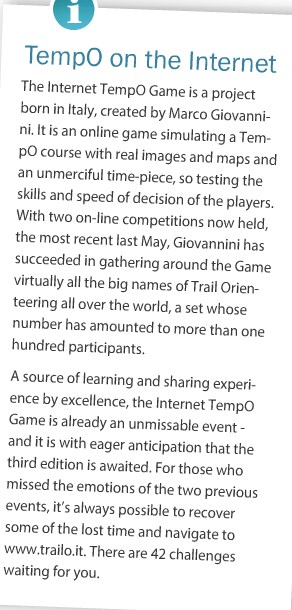
Pubblicato il 03/12/2013 09:44:19 | Webmaster
Italian board has decided the calendar of trailO in 2014 season:
| Date | Match | Rank | Place | Place |
| 23 February 2014 | Pre-O | Italy cup | Padova | ASD Padova Orienteering |
| 15 March 2014 | Temp-O | Italy cup | Milano | Cus Parma Orienteering |
| 16 March 2014 | Pre-O | Italy cup | Milano | Cus Parma Orienteering |
| 01 June 2014 | Pre-O | Italy cup | Asiago (VI) | ASD Erebus Vicenza |
| 14 June 2014 | Pre-O | Italian Champs | Masseria Provenzani (LE) | C.A. Sportleader ASD |
| 15 June 2014 | Pre-O | Italian Champs | Porto Selvaggio (LE) | C.A. Sportleader ASD |
| 28 June 2014 | Pre-O | Italy cup | Cansiglio Archeton (BL) | Or. Swallows Noale ASD |
| 29 June 2014 | Pre-O | Italy cup | Cansiglio Archeton (BL) | Or. Swallows Noale ASD |
| 14 september 2014 | Temp-O | Italian Champ | Pradis (PN) | ASD Semiperdo Maniago |
| 16 november 2014 | Temp-O | Italy cup | Alzate Brianza (CO) | ASD Orienteering Como |
Pubblicato il 31/10/2013 17:43:03 | Webmaster
IOF has published "new competition rules" bulletin about WTOC and International manifestations. You can find it here
...Pubblicato il 06/10/2013 17:37:34 | Webmaster
Last two rounds of ECTO are over and Lars Jakob Waaler has defend his leadership by the attack of Martin Jullum. This one has won both rounds in Plitvice (Croatia) but LJ has taken the third place in the last competition and he saved the first place. Third place in ECTO trophy is for William Rex who made two good performances (5° and 7° place) during this weekend. In overall standing of ECTO the best italian trailorienteer is Remo Madella (7° place and 119 points); good placement for Marco Giovannini (24° place and 60 points) and Renato Bettin (27° place and 58 points). The last tralO appointment in Italy will be on the 20th October with last round of Italy cup.
...Pubblicato il 02/10/2013 11:36:50 | Webmaster
Next weekend, in Plitvice (Croatia), there will be the last two rounds of ECTO; they are counted for Cro - Ita - Slo Cup too. Both competitions are PreO style. For the first time, the course setter Ivo Tisljar has informed the competitors about "Zero tollerance"; this matter is dibatted among the competitors to avoid mistakes about Zero controls. Good is the number of competitors: about 70 people splitted in three class. All the best competitors from Italy are there (except Guido Michelotti) and there are the current leader of ECTO, Lars Jakob Waaler, the gold medal of WTOC 2013, Jari Turto.
...Pubblicato il 01/09/2013 16:13:46 | Webmaster
Today, at Piani di Praglia, there was the first Italian championship of tempO; the winner was Michele Cera (he won the title in PreO - 2012 too) ahead of Enrico Gottardo (newcomer in trailO but "old fox" in foot-O) and the favorite Susy De Pieri. I can say the competition didn't keep up with a championship of TempO: 7 were the stations (4 taskes) but only 1 or 2 were tempO stations! the others were PreO stations.... too much controls were on hidden features or in incomprehensible zone of the map. If you spent a lot of time to understand the terrain, you weren't sure to answer well! so, many competitors decided to answer fast and to hope in lucky. The winner had almost 10 mistakes in 28 controls but the most of competitors had a percentage about 50% of right answers! If I used my "Zero strategy" (all Zero answers in 3 seconds) my score was in the podium! I hope the planner won't use the same method of planning in the next WTOC... You can find some photos on FB
...Pubblicato il 31/08/2013 22:19:09 | Webmaster
In a sunny day, at Monte Beigua, Renato Bettin (19 points) has won the sixt round of Italy cup. Now, his score is 60 points, in four rounds, and he can play for the final podium; a good confirm is the Pfister's result after Prà Catinat: he took the second place ahead of Gazzetto and Grilli, everybody with 18 points. There weren't Remo Madella, Elvio Cereser, Danieli Daniele and Guido Michelotti (course setter); Michele Cera is continuing his bad period: only 10th place! The competition was not too difficult but some controls have decided the final standing: in particular, time controls were very misleading and the nobody was able to avoid the mistakes. Guido, this time, didn't amaze us with great controls but the competition was tricky enough. Tomorrow, it will be the first Italian championship of TempO...
...Pubblicato il 29/08/2013 11:48:42 | Webmaster
Two competitions in Liguria this weekend: 6th round of Italy cup and the 1st Italian tempO Championship. Few competitors will be at Monte Beigua for this meeting because in the NW of Italy trailO hasn't many followers; the planners are Michelotti Giuliano and Guido. I remember the competitions of Guido are very interesting because he is able to create incredible clusters and controls. In Finland, Lauri and Antii are organizing another interest competition: news here
...Pubblicato il 18/08/2013 07:45:43 | Webmaster
During the second ITT game I wrote a lot of competitors from Hong Kong were playing; in the beginning I thought about some cheaters but I changed idea on this. This weekend there will be the national championship in HK: do you image how many competitors will take part in the competition? 20 people ? 50 people? no, there are 250 entries! Perhaps, only in Sweden or in Finland this is possible... Now, we wait for new great competitors from HK in next WTOC because among these competitors must be there any trailo's talent. In the last weekend of August there will be the national championship in Finland; Lauri, who thinks to the future, is organising some little expedients to make more interesting this competition....
Pubblicato il 12/08/2013 08:52:19 | Webmaster
Now you can follow "trailo.it" on FB; there is a group where it will be possible to show maps, photos, comments about the news and other taskes; this step was necessary because this site wasn't able to give that service. We are waiting for you on Facebook too.
...Pubblicato il 04/08/2013 09:47:01 | Webmaster
New round of Italy cup in Fenestrelle (Turin); August isn't the best month, in Italy, to organize trailo competition because the most of trailorienteers are on holiday around the world. But, this occasion was very special because very close at meeting point it's occuring the WMOC and a lot of foreign competitors were in competition ; so, more than 40 people were in Pra Catinat to play trailO.
Antonio Lo Grasso and Marina Beltramo have planned an interesting competition, not too difficult controls because the map was an orienteering map enlarged at 5000 scale and some details and features weren't mapped well. The terrain was a steep slop forest, in the first part, and a large open area in the last part. The controls were 23 + 4 TC; the most part of them were quite easy and only 4-5 controls were decisive.
At the finish only 4 people had the clear score: Nick Barrable, Remo Madella, Mark Heikoop and Renato Bettin. The difference among them was about the time controls: Nick and Remo were perfect (but Nick was faster than Remo) while Mark and Renato made a mistake (Mark faster than Renato); they have taken the first four place of standing.
At fifth place Guntar Mankus led a group of competitors with two mistakes: SJ Gaffney, Pfister, Cereser, Forstova.
Despite some rumors about a bad control nobody has presented any complain and the standing was confirmed.
The winner In A class was Antunin Forst and in paralimpyc class was Francesco Valentini.
Next italian meeting will be at the end of August in Liguria where the Michelotti's family will organize two competitions among which the first italian tempO championship....
Pubblicato il 31/07/2013 14:18:03 | Webmaster
Renato Bettin has won the overall standing of OOCup trailO; after three days of competitions he scored 52 points ahead of Christian Gieseler and Zoltan Mihaczi both one point less than him. The leader, after two rounds, Tomislav Varnica and other competitors didn't compete because Monday is a working day and they weren't on holiday. The winner of the last stage was Mark Heikoop, the last one who had one mistake; the competition was very different to the first and second stages; open areas and steep slope instead of forest and detailed terrain. The last competitors have given up to time controls due a sudden storm has gotten wet everybody.
| PRE-ELITE CLASS | DAY 1 | DAY 2 | DAY 3 | TOTAL | |||||||||
| Pl. | NAME | COUNTRY | P | T | Pl. | P | T | Pl. | P | T | Pl. | P | T |
| 1 | Renato BETTIN | ITA | 15 | 28 | 6 | 20 | 33 | 1 | 17 | 29 | 4 | 52 | 90 |
| 2 | Christian GIESELER | GER | 15 | 83 | 9 | 19 | 25 | 3 | 17 | 34 | 5 | 51 | 142 |
| 3 | Zoltán MIHÁCZI | HUN | 16 | 85 | 3 | 18 | 88 | 9 | 17 | 15 | 2 | 51 | 188 |
| 4 | Ivana GOBEC | CRO | 15 | 39 | 7 | 19 | 86 | 4 | 16 | 27 | 8 | 50 | 152 |
| 5 | Mark HEIKOOP | NED | 13 | 88 | 16 | 18 | 35 | 7 | 18 | 27 | 1 | 49 | 150 |
| 6 | Elvio CERESER | ITA | 15 | 74 | 8 | 18 | 80 | 8 | 16 | 29 | 9 | 49 | 183 |
| 7 | Damir GOBEC | CRO | 16 | 85 | 3 | 17 | 84 | 13 | 15 | 16 | 10 | 48 | 185 |
| 8 | Mateja KERESTEŠ | SLO | 12 | 14 | 18 | 17 | 80 | 12 | 16 | 14 | 7 | 45 | 108 |
| 9 | Stefano GALLETTI | ITA | 13 | 103 | 17 | 15 | 94 | 18 | 17 | 40 | 6 | 45 | 237 |
| 10 | Bohuslav HULKA | CZE | 13 | 36 | 14 | 16 | 55 | 16 | 15 | 27 | 11 | 44 | 118 |
| 11 | Emil KACIN | SLO | 13 | 79 | 15 | 14 | 75 | 20 | 17 | 16 | 3 | 44 | 170 |
| 12 | Feike ALEWIJNSE | SLO | 14 | 82 | 11 | 13 | 98 | 24 | 14 | 31 | 14 | 41 | 211 |
| 13 | Timi ČIŽEK | SLO | 13 | 21 | 13 | 17 | 40 | 11 | 11 | 240 | 21 | 41 | 301 |
| 14 | Igor BONČINA | SLO | 11 | 149 | 20 | 14 | 158 | 22 | 14 | 27 | 13 | 39 | 334 |
Next appointment on next Saturday in Fenestrelle to Italy Cup round.
...Pubblicato il 29/07/2013 10:27:56 | Webmaster
After two competitions, in OOCup manifestation, the winner isn't till sure; Tomislav Varnica is leading with 36 points and 168 " ahead of Renato Bettin (35 p + 61"), third place for Christian Gieseler (34p. + 108") and the followers are Ivana Gobec (34 p. + 125") and Zoltan Mihaczi (34 p. + 173").
On the first day the winner was Marco Giovannini ahead of Tomislav Varnica and Damir Gobec; on the second day the winner was Renato Bettin ahead of Zdenko Horjan and Christian Gieseler. A lot of complains about the controls but only three answers weren't good; the maps are foot-orienteering type and only few days ago they were available to the setters.
Today the last competition will be in open area and not in the forest like the first and second stage.
| N. | COMPETITORS | P | T |
| 1 | Tomislav VARNICA | 36 | 168 |
| 2 | Renato BETTIN | 35 | 61 |
| 3 | Christian GIESELER | 34 | 108 |
| 4 | Ivana GOBEC | 34 | 125 |
| 5 | Zoltán MIHÁCZI | 34 | 173 |
| 6 | Zdenko HORJAN | 33 | 110 |
| 7 | Susy DE PIERI | 33 | 151 |
| 8 | Elvio CERESER | 33 | 154 |
| 9 | Damir GOBEC | 33 | 169 |
| 10 | Jasminka CINDRIĆ PERKOVIĆ | 32 | 98 |
| 11 | Mark HEIKOOP | 31 | 123 |
| 12 | Timi ČIŽEK | 30 | 61 |
| 13 | Bohuslav HULKA | 29 | 91 |
| 14 | Mateja KERESTEŠ | 29 | 94 |
| 15 | Stefano GALLETTI | 28 | 197 |
| 16 | Emil KACIN | 27 | 154 |
| 17 | Feike ALEWIJNSE | 27 | 180 |
| 18 | Piero LABANTI | 26 | 198 |
| 19 | Igor BONČINA | 25 | 307 |
| 20 | Dalibor PERKOVIĆ | 23 | 197 |
| 21 | Antonio HERNANDEZ FERNANDEZ | 22 | 223 |
| 22 | Diana MIHÁCZI | 20 | 249 |
| 23 | Adam MIHÁCZI | 20 | 297 |
| 24 | Antonia HOLPER | 19 | 163 |
| 25 | Joachim STAMER | 17 | 22 |
| 26 | Marco GIOVANNINI | 17 | 23 |
| 27 | Edi OCVIRK | 17 | 111 |
| 28 | Kreso KERESTES | 15 | 25 |
| 29 | Anja BABIC | 8 | 34 |
Pubblicato il 25/07/2013 21:02:47 | Webmaster
While in Sweden, Marko Maattala is leading the Oringen's standing after 4 rounds, about 30 people will be in Bohinj (Slovenia) to compete for OOCup; all three competitions will be PreO format and the winner will be the most precise and not the fastest. Among the competitors there will be the setters (Kreso and Marco) but they will play only for the single competition. Very difficult is to bet about the winner: from Italy there are Renato Bettin, Elvio Cereser, Susy De Pieri and Stefano Galletti, from Croatia Zdenko Horjan, Damir Gobec, T. Varnica and Jasminka Perkovic, from Netherlands Mark Heikoop, from Germany Christian Gieseler, from Hungary a good group of trailorienteers; other Contries are present: Czech R., Spain, and of course Slovenia. Two competitions are valid for Cro-Ita-Slo cup and one competition is the Slovenia's championship.
Follow the competition clicking on the link...
Pubblicato il 17/07/2013 22:22:40 | Webmaster
Now, it's possible to see the gold book of the WTOC, ETOC, and World cup.
Here...
Pubblicato il 15/07/2013 18:37:16 | Webmaster
Everybody know the final standings of WTOC 2013: Jary Turto, Jana Kostova and Pinja Makinen are the gold medal in Preo Open, Paralimpyc, TempO classes. So, what can I add to this news?
I think it was a good WTOC: not surprises in the standing, a good terrain, good organisation. Some words about the courses setting: the most part of the controls were in forest where the countour
lines were gradual and the experience of Scandinavian competitors was very important. The most part of the clusters were set there and the competition of Preo was a little bit boring. The second part
of day 2 was a little diffent and its controls seemed very similar to south Europe setting style. There were some controls where Z tollerance was very important: I'm thinking about control n.1 in both
days! In the first competition, everybody have understood that A flag was in the right reentrance but somebody have aswered Z because the flag was picked very close at the end of the reentrance
(50 cm. far of the right place); the same example about n.1 of second day: the correct flag (B) was 1,5 m. higher than right contour and 2 m. far of the center of the circle. In both cases it could be
very simple to pick the flags in the right place to avoid the protest. I found very incredible the motivations about the reject of the protests: lineguides are only suggestions and every control have to
be guess using past competitions... in Italy, we ask this type of answer "Ponzio Pilato" related to the Roman emperor. Some paralimpyc competitors have protested about n.7 (day 2) because they couldn't
see the flags out of point of view: Jari is 2 m. tall and he's jumping during the n.7 resolution... this type of control isn't fair because the tall can't be a skill of trailO.
However, it's clear we have three groups of competitors: the top competitors, I'm thinking about the Scandinavian Countries and some competitors of Europe which have great talent (Lestinsky, Michelotti, Kyrichenko,
A.Straube,); the second group of the competitors: they are very good competitors but they need another one steep to reach the top. Here I'm thinking about the best competiors of Croatia, Slovenia, Italy,
Czech R. and other Countries. The last group is two steeps behind the top and I'm thinking about good competitors who need more experience to avoid stupid mistakes or they have to train more to solve very
tricky controls (I am an example of this group).
Some words about Pinja: I think she's the future type of competitors; I believe in the next future some elite foot-orienteers will begin to play this discipline.During the ITT game, I saw that some finnish guys, who
never seen in trailO competitions, made a very good score. I know the training of these young orienteers is very hard and they are able to solve very fast the controls.
Next year the WTOC will be in Italy and ETOC in Portugal: we already wait for new medals.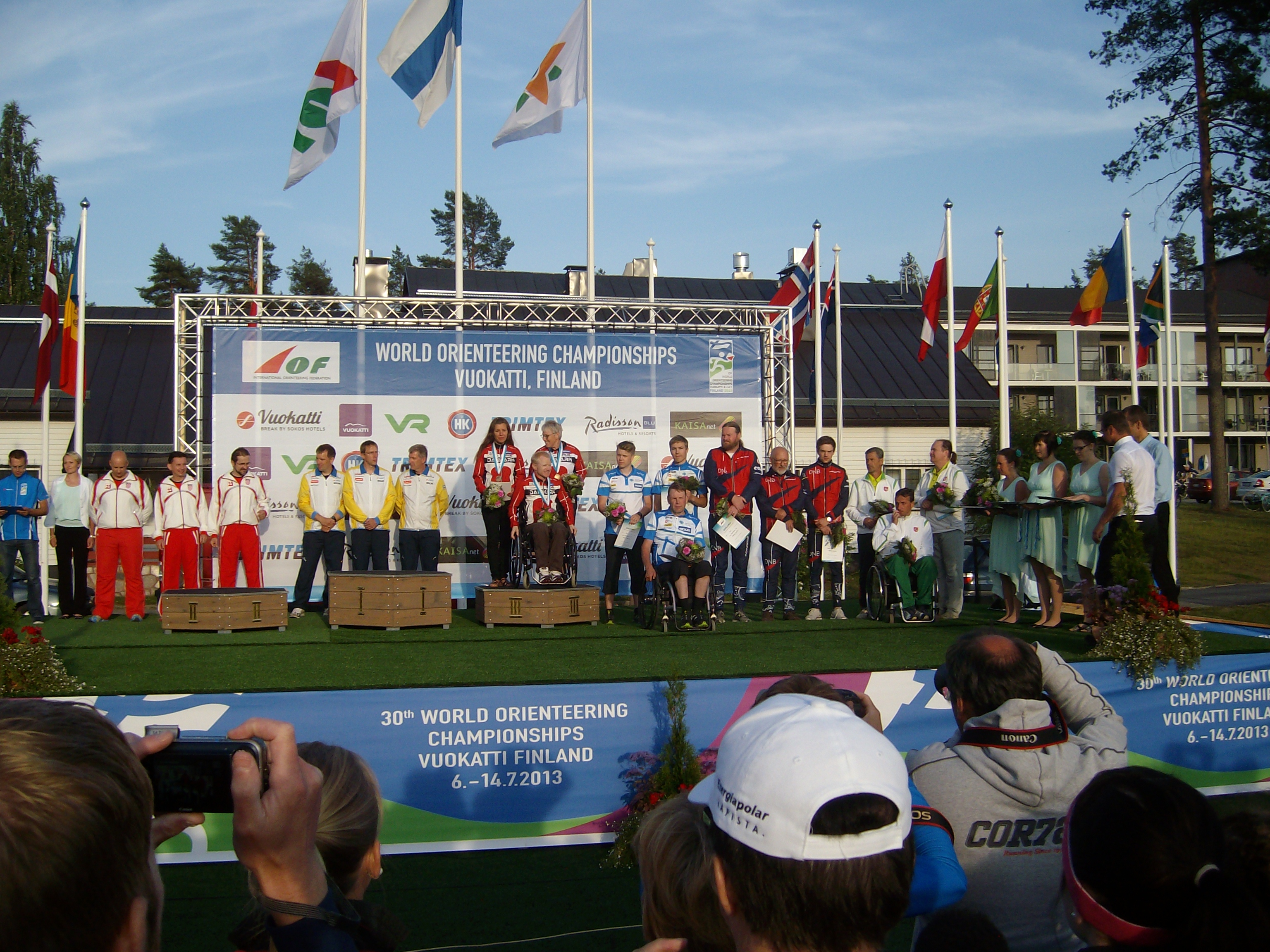
Pubblicato il 10/07/2013 21:53:31 | Webmaster
Today first round of WTOC: in Open class the best were Jari Turto (24 + 32") and Martin Fredholm (24 + 82"); in 3rd place was Antii Rusanen the only one with 23 points. There were seven competitors with 22 points and among these there were Guido Michelotti (8° - 85") and Remo Madella (10° - 134"). Very bad the Marco's competition (35° - 16p - 42"); many mistakes and not well performance. In paralimpyc class the podium was for Czech: Jana Kostova 23p ahead Pavel Dudik 21p and MIchael Johansson (21p); Francesco Valentini was 32° with 8 points.
Tomorrow, the second round which is valid for team standing too....
Pubblicato il 07/07/2013 22:20:28 | Webmaster
After the weekend of Selkie Remo Madella has become "the man of the moment"; everybody ask who's him and if he could be the next World champ. I know him since 1998 when we were in same club; during the last years he has travelled a lot of km travelling the Europe and to compete in many Countries. His progress in trailO discipline has been ever increasing despite the Italian movement didn't keep the same pace; now, he has found a good feeling with Scandinavian maps and terrains because he has planned the last two years to this WTOC. I don't know if he will be able to take the podium in Vuokatti but he showed that some years to work one's way up now he has reached the best trailOrienteers of the world achieving their respect. Good luck Remo. ...
Pubblicato il 01/07/2013 10:20:15 | Webmaster
The past weekend, in Latvia, there were two rounds of ECTO: my reporter from Miķeļtornis has described the terrain very tricky but the maps were not well drawn. The competitions were fun although some controls were not clear. The winners were K-char: Kobzarev Aleksandr (Russia) won first day, Kyrychenko Vitalii (Ukraine) won the second day. Good results, in both days, were for Shmatov (2° and 7°), Jovaisa (3° and 5°), Normund Narvaiss (4° and 9°), Ivans Peteris (3° and 8°), Zita Ruksane (9° and 10°).
The leader of ECTO, Lars Jakob Waaler has to forget this "two days" because his placements (13° and 32°) were so far as his reputation. Good news to Remo Madella (the only one italian trailorienteer competitor): 11th place the first day and 2nd place in the last day.
Next rounds of ECTO will be in October in Croatia but in July there will be the most important event of season: WTOC.
...
Pubblicato il 27/06/2013 12:25:57 | Webmaster
I have updated the overall standing of Cro-Ita-Slo. HERE...
Pubblicato il 26/06/2013 11:53:49 | Webmaster
Now, the overall standing of ECTO and of ITOC are update. I remember you the final standing of ECTO is the sum of the 5 best scores. Next weekend, in Latvia, there are two competitions admit for ECTO.; both are Pre-O format. Link below......
Pubblicato il 23/06/2013 21:05:51 | Webmaster
At this moment, I haven't the final results because after the finish (and when I copied the standing) the control n.5 was erased.
But the discussion about this weekend of trailO remain: how is possible that Martin (37th place yesterday) won today and Lars J. (winner yesterday) dropped to 40th place? How is possible Stig Gerdtman (WTOC champ) arrived around 20th place in both competition and Marit (European Champ) took places over the 35th place? Simple: in the fantasy trailorienteering of Roberta Falda everyone can win! remember this news during the next WTOC (2014) in Italy...
I think, to wait for an hour before tempO controls (in the middle of the competition), was an awful idea; wrong descriptions (A class had number 31,32,33, instead A-E letters), full magenta circles not cropped, wrong alignment features, point of views free, all these reasons have created a low profile competitions.
Unfortunately, I can't give you the official result but I can write Martin J was in the first position (21 points) ahead Erik Lundkvist and Jari Turto. The winner of overall standing was Erik ahead Daniele Danieli and Marina Borisenkova.
Italian champion 2013 is Danieli Daniele ahead Renato Bettin and Remo Madella.
When I will have the official results I'll update the ECTO standing. ...
Pubblicato il 23/06/2013 07:53:40 | Webmaster
This is only a breaking news because I haven't (not only me) the final standing.
After the finish, in the meeting point, everybody asked: "Who is Gazzetto?" I thought about Gazzerro (President of FISO) but the question was about the current leader! This italian competitor is a good trailorienteer but he never won a competition in Italy; the story of the first day of ITOC (and ECTO) is not a good news for trailO: the project was to have 18 controls (16 +2 T.C.) but one was erased before the start and a second one was cancelled after a double protest about number 5 (erased) and 8. It's clear the best competitors have mistaked about three controls: number 5, 8 and 12. The most problem was to understand the Zero tollerance (as Lauri calls it): in some controls the flags were 2/3 meters far away from the center of circle... The provisional standing was: Lars Jakob Waaler (16 points and 12"), Hannu Niemi (16 and 13" ), Gazzetto (16 and 37"); they are the only three (Gazzetto had 17 points before the protest) who have scored 16 points. With 15 and 14 points there are a lot of people but I can't tell you the right position after the protest. I remember the situation about ITOC: Gazzetto (16), Danieli, Madella, Cereser, (all with 15 points) and other large group (Giovannini, De Pieri, Bettin, Lenarduzzi) with 14 points. The site of manifestation and the news about the competition aren't updated in time and this is not a good news about WTOC 2014....
Pubblicato il 18/06/2013 11:17:31 | Webmaster
Do you remember 2^ edition of ITT? Trakoscan's tempO was at the same level of difficult. This competition has sparked a debate around the format of this discipline: option A, easy answers and time of solving about 10-15 seconds and 30" penality; option B, answers maked more complex and 45" penality. It remembers the same debate around sprint CO format some years ago.
At present moment we have some rules but the planners haven't adequate experience to plan the right format. Jasminka has planned some controls very difficult: the problems were to see the right feature in the terrain so, some answers were given hoping to get lucky.
Said this, the standing is very clear: the best trailorienteers are always in the top positions! the winner was Ivo Tisljar (720"), 2nd Kreso Kerestes (732"), 3rd Goran Markovic (746") and 4 th Mihaczi Zoltan (761"); they used different strategies: Ivo, Goran and Zoltan were very fast but had 13-14 mistakes, Kreso and Ivica (5th - 839") were less faster than them but had 9 mistakes.
Italian trailorienteers didn't shine but they has taken the 6th place (Remo 855" - 13 errors) and 7th place (Marco 931" - 11 errors); in the rest of standing we found a lot of young people from Croatia: this is good news for trailO and we hope they were scared by the difficult of TempO....
Pubblicato il 09/06/2013 20:45:17 | Webmaster
Sometimes, the planner of TrailO are able to surprise the best trailorienteers; in Rogla, Kreso has planned 21 controls (19+2TC) among the meadows and the forest using alignments, microforms of terrain and colors. Some flags were wery close each others and this type of PreO is very difficult to understand and to explain. So, the podium was quite surprising: first place for Damir Gobec, second place Alewijnse Feike, third place for Susy De Pieri. On Saturday evening, there was the night - O competition: the winner was Jasminka Perkovic ahead Marco Giovannini and Renato Bettin.
The final result of three days competition is: the winner Remo Madella, second place Susy De Pieri, third place Jasminka Perkovic.
Next round of Cro-Ita-Slo is on Sunday 16th in Trakoscan (Croatia)...
Pubblicato il 09/06/2013 08:16:08 | Webmaster
Crazy time during the tempO competition: the some minutes before to start the weather decided to give us a little of hail! after this pause the tempO competition was regularly done despite the soft rain has disturbed the competitors. Seven stations with 5 taskes in each of them; Remo Madella won clearly with only a mistake and the score of 220". Behind him, Susy De Piery and Ivo Tisljar but their scores was 100" higher. Good positions for Elvio and Renato in 4th and 6th position; Marco was 11th because his strategy (all answers Z in 1 second) hasn't payed. The terrain was a classic park terrain among the houses and tennis courts of Rogla. In the evening there was the night-o and today the PreO competition....
Pubblicato il 07/06/2013 07:24:01 | Webmaster
After the week of ITT, the trailorienteers of south of Europe will come back in the forest; the event is the next round of Cro-Ita-Slo in Rogla (Slo) on 8th and 9th of June. There will be three competitions (TempO. Pre-O, Night-O) before to travel some km. and to go in Croatia where Thermeland open (CO competition) will start. On Sunday 16th, in Trakoscan (Cro) during the Thermeland manifestation a new round of Cro-Ita-Slo where some people from Hungary will come. After this week, everybody will be in Trentino to compete at the Italian championship and the pre-warning of WTOC 2014.
...Pubblicato il 05/06/2013 13:52:44 | Webmaster
During the last day a lot of people have played the game; there are over 100 people in the final standing and this is my personal satisfaction.
The cup of ITT game is flying toward Sweden from Finland: Christian has played using the right strategy. The best score in the "right controls" results and the exact speed; second place to Martin (NOR) who has hoped untill last hours to win the title. Third place to Marko (FIN) who was able to answer very well in the first station (the difficultiest); behind them the Italian surprise Raus who has used the strategy of speed: many mistake but only 10/15 second every station. Another Christian in the fifth place: I'm happy because he's the first one who plays from Germany; sisth place to Stoyan (UKR). As you notice there are six different flags and this is the true achievement of this edition.
See you to next edition....
Pubblicato il 04/06/2013 07:30:24 | Webmaster
Yesterday, some good guys has tryed to beat the wall of 1000"; the podium is under this line and some results are very close to this limit but not enough. We waited for Antti but his performance wasn't brilliant (1118" and 32 right); better than him was another finnish competitor: Jari needed only 14 seconds over the wall! (1014" and 36). Great competition for Manix: he has taken the fourth place and bring his flag (GB) in top five (1004" and 34). Today is the last one: I hope to reach the same competitor as the first edition; the best have played but tempO isn't a rational game and somebody else could try to break the wall....
Pubblicato il 03/06/2013 07:14:54 | Webmaster
The most part of trailorienteers, yesterday, have competed in their Countries; the Norwegian people too but after the TempO'scompetition Martin wasn't happy of his performance. So he decided to play his card in ITT to understand if he could be again a good specialist. His result was incredible: record of right score (46) and final score (801") excellent... other Norwegian guys have tryed ITT: Toraaa (1102" and 29) is in top ten, Mini (1131" and 28) is eleventh. Who will be able to fall Marit and Pinja out of the podium? there are not many people: Antti, Lars Jakob, Saku, some others.......
Pubblicato il 02/06/2013 08:31:49 | Webmaster
During this week end, there are some manifestations in Europe so the world of Trailorienteering is not at the PC. In a quiet Saturday, Italy has played its best card: Guido Michelotti! his performance was very very fast but he has made 25 errors! he has decide to use the strategy number 1 (let read the old post) and he has taken the fourth place two second behind Guntars. In the evening, John K. has challenged the English people to beat him and one of them, JJJL has scored 1059" and 37 errors making better than JKGB.
Today, I think will be another quiet day but I hope on Monday and on Tuersday the last finnish pleople will play their cards....
Pubblicato il 01/06/2013 08:18:05 | Webmaster
In the first edition, the Coutries more numerous were Finland and Latvia; during this edition I'm seeing many people from Hong Kong but not from Latvia. I have written to Janis and the Latvian competitors are coming to play. One of the best Latvian is Guntars: in the first edition he was 13th... yesterday, he played his chance and the result was good: third place (1029" and 40 right controls)! another specialist, Kreker from Slovenia, has taken the fifth place (1085" and 45) and he has the record of right answers.... I admit this edition is very tricky; I see many quick competitors to mistake a lot of controls and the slower of them are able to answer well but not so fast to win. The average for every station is about 90": you have to decide if to use all that time and don't mistake or to need less than 60" with one mistake..... It's a game's strategy!
...Pubblicato il 31/05/2013 08:09:27 | Webmaster
Do you think TempO is a discipline to old man or disable people yet? You are wrong! in these years some young people have started to play it and now, you can see the results...
ITT Game is a window on this discipline; during the second day of ITT, some "great names" have played their cards. The first one was Remox, he was the better Italy's competitors but not the best (1247" and 33 errors); the second one was Marit and she has played very well (not like in the first edition) and her score was the first one under 1000 seconds (995 and 38). The next one was JKGB and his score was very good (1150 and 36) immediately behind the first day's leader Hongkongstyle. In the evening, Lauri ( 1053 and 36) tryed to take first place but he had the same time score than Marit but he made two mistakes more than Swedish girl. In the night, the surprise from Finland: Pinja Makinen! from the first edition of ITT, I'm following her performances and I'm not surprised about her score; she needed more time than Marit but she had hitten 44 right controls! now, the best time is 975 and it will not easy to Antti, Martin or somebody else to win this edition. I want to tanks all the competitors from Hong Kong: I can say: "HK has discovered ITT!"
Pubblicato il 30/05/2013 07:30:38 | Webmaster
After first day, Hong Kong is the Country leader of ITT: "Hongkongstyle" is the player who has scored the best result (1143" and 33 right controls). The second place is for Portugal with "Xeriph" (1243" and 37) and Jiri Fiser (Czech R.) has taken the third place (1287" and 40). Only fourth place for "Mamma Susy" who is the Italian specialist at next WTOC; The bronze medal of the first edition, Saku, has started his performance and after three stations his score is good but there are others stations to defeat... After the first day, I can observe there are only 2 stations very difficult others are easier.
...Pubblicato il 28/05/2013 22:41:34 | Webmaster
Hi trailO friends, untill 4th June you can play the 2nd edition of ITT Game. Click on the link and look at the green button on the botton-right page.
...Pubblicato il 26/05/2013 14:25:18 | Webmaster
The Italian Trailo's Chief has selected the athletes for WTOC 2013 in Finland:
Team leader is Remo Madella (Preo and TempO), Guido Michelotti (Preo and TempO), Marco Giovannini (Preo), Susy De Pieri (TempO), Francesco Valentini (Paralimpyc).
Eventual benches are Michele Cera (Preo) and Renato Bettin (TempO). Guido doubted about his presence due to his work but it seems he could be at the start; the coach had a difficult choise between Marco and Michele because Michele has won some competitions in Italy but his international experience is poor respect Marco who played well during the ECTO's manifestations. Despite Renato was better than Susy in the last TempO's match, the coach has selected Susy who has played well during the old TempO's competitions.
Next appointments are on June: on 8th and 9th in Rogla (Slovenia), 16th in Trakoscan (Croatia), 22nd and 23rd in Folgaria (Italian Championship).
Remo Madella, this weekend, is in Sweden and he has collected some good results (around tenth position in all the competitions); he need another step if he want to take the podium in WTOC.
Pubblicato il 21/05/2013 11:58:14 | Webmaster
After four rounds, ECTO's standing begins to show the real value of competitors; Lars Jakob Waaler adds 87 points to his score and now he has 148 points. Behind him, Ola Jansson (109 p.) and Stig Gerdtman (107 p.) seem in good shape but their middle score don't help their for the victory; William Rex has lost the leadership having 19 points more than after Norway's round. The real risks for Lars are Antii Rusanen (92 p. but only 2 results) and Lauri Kontkanen (78 p. and only 2 results) while Lennart Wahlgren and Marit Wiksell haven't sufficient good results to be in the top three. I remember you, the overall standing will be arranged with the five best scores.
54 people have at least one point and 137 are the competitors untill now; the next step will be in Italy on 22nd and 23rd June
Pubblicato il 20/05/2013 13:25:39 | Webmaster
Some years ago, I competed in Finland and I saw many old people who won the overall standing; I thought trailO was a discipline only for them but I didn't understand the reason. This week end I came back in Finland and I saw many new young faces and the combined results has told me that the trailO is changed. It's clear that PreO is an old discipline because only the faster competitors can win the manifestations. During the tempO competitions I have seen Antii, Lauri, Marit, Martin and other few people: I was very impressive to see their speed during the answer's time. I try to imitate them but my result wasn't the same.... congratulation to them!
Now, same numbers: four competitions, five standing, 90 competitors.... a very intersting weekend between Tampere and Turku. Antii Rusanen (79 points) has won the FintrailO competition in front of Lauri Kontkanen (78), Marit Wiksell (78 and 62"), Martin Jullum (78 and 86"), Martin Fredholm (77 and 60"); italian competitors were Remo Madella 13th (75 and 42"), Marco Giovannini 17th (74 and 20"), Renato Bettin 21th (73 and 33"), Elvio Cereser 34th (71 and 73"), Michele Cera 37th (70 and 25"), Susy De Pieri 59th (67 and 97"), Alberto Grilli 64th (65 and 39"), Giuliano Michelotti 69th (64 and 68"), Dario Citterico 73th (63 and 71"), Fulvio Lenarduzzi 78th (62 and 38"), Emilia Arcaleni 79th (62 and 96"), Marina Beltramo 83th (53 and 41").
Another possible long list of results is ECTO cup but I invite you to watch the link's site or to wait when I have finished to insert them in my database.
Pubblicato il 12/05/2013 07:31:07 | Webmaster
On 18th and 19th May in Finland there will be the third and fourth round of ECTO. In both days there are scheduled four competitions, two Preo and two TempO; the Saturday's Preo competition and Sunday's TempO competition will give scores for ECTO's overall standing. A new formula is used in this occasion: during the PreO competition won't be the time controls but the first station of TempO competitions will set the position of those who have the same right control in the Preo competition!
Nearly 90 people will take part in TrailO's manifestation: Sweden, Finland, Norway, Latvia, Russia are the nations more numerous but Italy has a good number of members in Kokemani.
The best Italian trailOrienteers will be in Finland only Guido couldn't be there; Remo will try to take the top ten place, Michele will be the Italian new entry as nobody (in Scandinavia) knows him, Elvio, Renato, Marina, Alberto, and the others already know the Finland's terrain and Marco will try to repeat the good competitions in Norway.
The next week, the Board of Italian Federation will call the five people who will go at WTOC.
Pubblicato il 03/05/2013 17:41:26 | Webmaster
Hi friends, I think is time to play second edition of ITT. The date could be the last week of May, after the second round of ECTO (Finland) and before the third (Italy). On June, I'm busy about TrailO's competitions and I can't follow the game. I will send an email to everybody who has registered during the first edition. Stay tuned......
Pubblicato il 22/04/2013 14:21:35 | Webmaster
After a hard job, now you can see the results of both competitions and the overall standing after two rounds. You have to click on "international" and then "ECTO"; there you can see the overall standing. If you want see the single result click on the date of the competition and it opens a new windows. For detailed result go directly at organizer's website clicking on "Organizzatore".
...Pubblicato il 21/04/2013 23:25:11 | Webmaster
Second day for ECTO and Norwegian Spring: a very interesting competition in the forest among rocks, knolls, hills and contour lines. Martin has planned another good round with easy controls and others very difficult like n. 6 (only 28% right answers). Only three people had the maximum score: Lars Jacob Waaler (23"), William Rex (32"), Erik Lundkvist (34"). Behind them 7 competitors had one mistake: Stig Gerdtman (28"), Tomas and Ola Jansson (33"), Martin Fredholm (34"), Marco Giovannini (36"), Michael Johansson (42") Rolf Karlsson (43"). Eleventh place for Marit Wiksell who has improved her position after the first day: incredible her time controls: only 14"!
The overall standing of ECTO is for William Rex ahead Ola Jansson and Lars Jacob Waaler. Next round is on May in Finland: there will be the finnish guys who were not present in Oslo.
Next week, I upload the "International" results where you can find (on ECTO menù) the single results and the overall ECTO standing.
Pubblicato il 20/04/2013 19:39:49 | Webmaster
The first round of ECTO is gone: Martin Jullum has planned 20 controls (plus 2 time controls without score's value); the first part was in the forest using rock and contour lines and the second part with some long distance flags in open area. I think the competion has been good and the map well revised. Five Swedish guys had managed a perfect score: Ola Jansson (16"), Michael Johansson (20"), William Rex and Stig Gerdtman (22") and Lennart Wahlgren (79"). Behind them 8 people had one mistake; first one who don't belong to Scandinavian countries was Tertsunen (10th and the only finnish), behind him a couple from Latvia: Guntar Mankus (14°) and Zita Ruksane (15°). Marit Wiksell will have to forget this competition because her 39th place is not her value. Italian team has played quite well: Marco Giovannini (19°) and Renato Bettin (22°) had two mistakes while Fulvio Lenarduzzi (31°) had three mistakes; Francesco Valentini has found many difficult to understand this type of terrain and his position is 72° place.
Tomorrow there will be the second round and everybody will try to do better.
Pubblicato il 18/04/2013 17:58:45 | Webmaster
This weekend, in Ostfold (Norway), it will start the unofficial ECTO (European cup of trailorienteering). Two are the rounds: every match will give some points for each position. The winner of ECTO will be who will have the highest score possible using 5 or less rounds. At this moment, 74 are the competitors in open elite; the most part of them comes from Scandinavia but there are competitors from Latvia and Croatia. Four people will rapresent the country of Italy: Bettin, Giovannini, Lenarduzzi and Valentini.
It will be very hard for them to reach the top ten but nothing is decided before the finish. The favourites are Marit Wiksell, Stig Gerdtman, Waaler's family, Fredholm's dynasty, Taxth Loland, G. Mankus, Oien, Tisljar I. and others.... but, I'm very courios to see one competitor: Olav Lundanes! I'll try to keep update you.... (if I'll find a free internet).
Pubblicato il 10/04/2013 12:39:53 | Webmaster
Hi friends, next edition of ITT Game is ready but I have to decide when it'll start. Somebody of you have asked me if it's possible to create and to publish some games. If you want do it, please send me (contact@trailo.it) an email; I'll say you what I need. In the future, I'll look for a procedure where you can upload directly your images.
About next edition ITT, I can say there will be 11 games and 5 controls each game; I have mixed easy and hard controls, maps and terrains.
Pubblicato il 07/04/2013 21:05:45 | Webmaster
This weekend, while the best italian trailorienteers were in Rome, Remo Madella and Valerio Pfister were in Sweden to compete in some round of Sweden's calendar. The level of competitions was very high because the best Norwegian, Czech and Danish trailorienteers were present. Martin Jullum, Marit Wiksell, T.Loland, Stig Gerdtman were some of the "great" names in the competition; Remo, after first round (18th place) has reached two times the top ten: this is a good signal for his feeling towards the WTOC.
Valerio Pfister has competed well but the Nordic competitions have a number of excellent trailorieenters and his position is not so good than Remo.
On 20th April, in Norway, there will be the first round of EOTC but Martin couldn't win the competition (he's the planner).
Pubblicato il 28/03/2013 12:39:58 | Webmaster
After Easter's weekend, trailO competitions will restart; on Saturday 6th April, if you will be in Rome to visit the city or to listen to Pope Francesco, you can add this appointment: Villa Pamphili at 11 a.m. The competition will be a round of Italy cup and you can find information here. On 20th April, it will start the first edition of European cup in Norway: despite the most part of Italian orienteers will be at Italian championship (middle distance), I think some trailorienteers could be at EOTC. I'm thinking to add the result of EOTC on world champs webpage.
...Pubblicato il 21/03/2013 13:35:54 | Webmaster
At this moment I haven't find news about 2013's edition of Cro-Ita-Slo trophy; therefore, I have calculated the scores of 4 competitions and I have created a provisional standing: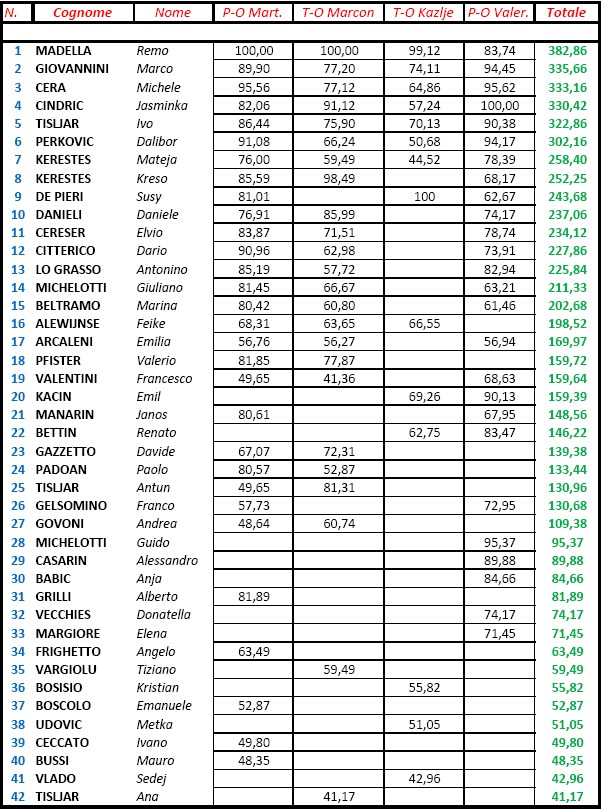 ...
...
Pubblicato il 19/03/2013 21:24:31 | Webmaster
IOF' s website has publicized the calendar of ECTO 2013; 10 are the competitions and 5 Countries will host these competitions:
Norway on 20/21 April
Finland on 18/19 May
Italy on 22/23 June
Latvia on 29/30 June
Croatia on 5/6 October
The overall standing will be composed by the sum of the points for the best 5 results: only the best 27 competitors will have the score.
Click on link to see IOF page.
Pubblicato il 17/03/2013 22:41:02 | Webmaster
New round for Italy cup and Cro-Ita-Slo trophy, today, in Valeriano (Italy); the best trailorienteers of Italy, Slovenia and Croatia were in competition in a cold afternoon. The map was a long stripe with only a path in the center; one side was a steep slope (contour line 5 m.) others side a torrent with micro reentrances. Some controls were "old style" and some competitors have fallen on ambiguos controls. Only Jasminka Cindric Perkovic (CRO) was able to answer cleany to all 16 control and only very difficult time control has soiled her performance. Behind Jasminka, again the couple Michelotti jr.(3) and Michele Cera(2) (both are Italian champs) have taken the podium despite two errors in the competition; fourth and fifth were Marco Giovannini and Dalibor Perkovic with the same two errors. Only tenth place for Remo Madella who didn't like this type of competition; the problems were for other "great names", too.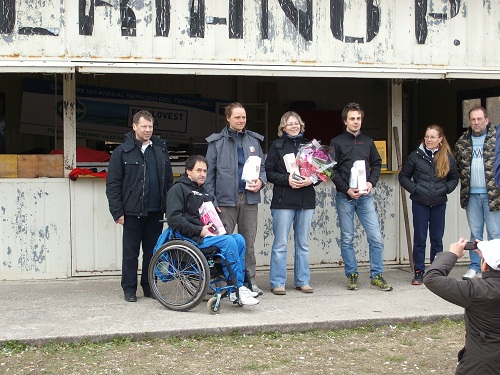
Pubblicato il 09/03/2013 21:19:47 | Webmaster
Third round of CRO-ITA-SLO 2013 in Slovenia during Lipica cup CO manifestation.
Today, in a raining day Kreso has planned 8 stations and 5 tasks for each station. The stations were scattered among yellow meadows and spare bushes; personally, I have learnt "upper part" of a long knoll, description not very used. Unfortunately, the water has made difficult the change of task because the plastic pages were joined. A good number of competitors were at the start despite the bad weather; among the best italian trailorienteers there weren't present Elvio and Guido M.
The winner was "Mamma Susy" (nickname used during ITT game) ahead Remo Madella (Remox) and Marco Giovannini (ITT planner); fourth place for Ivo Tislijar whereas Emil (5th place in ITT) Jasminka, Renato B., Michele Cera weren't in their best day.
Next sunday, in Bosco di Valeriano (Italy), new round of Italy's cup with all the best trailorienteers at the start.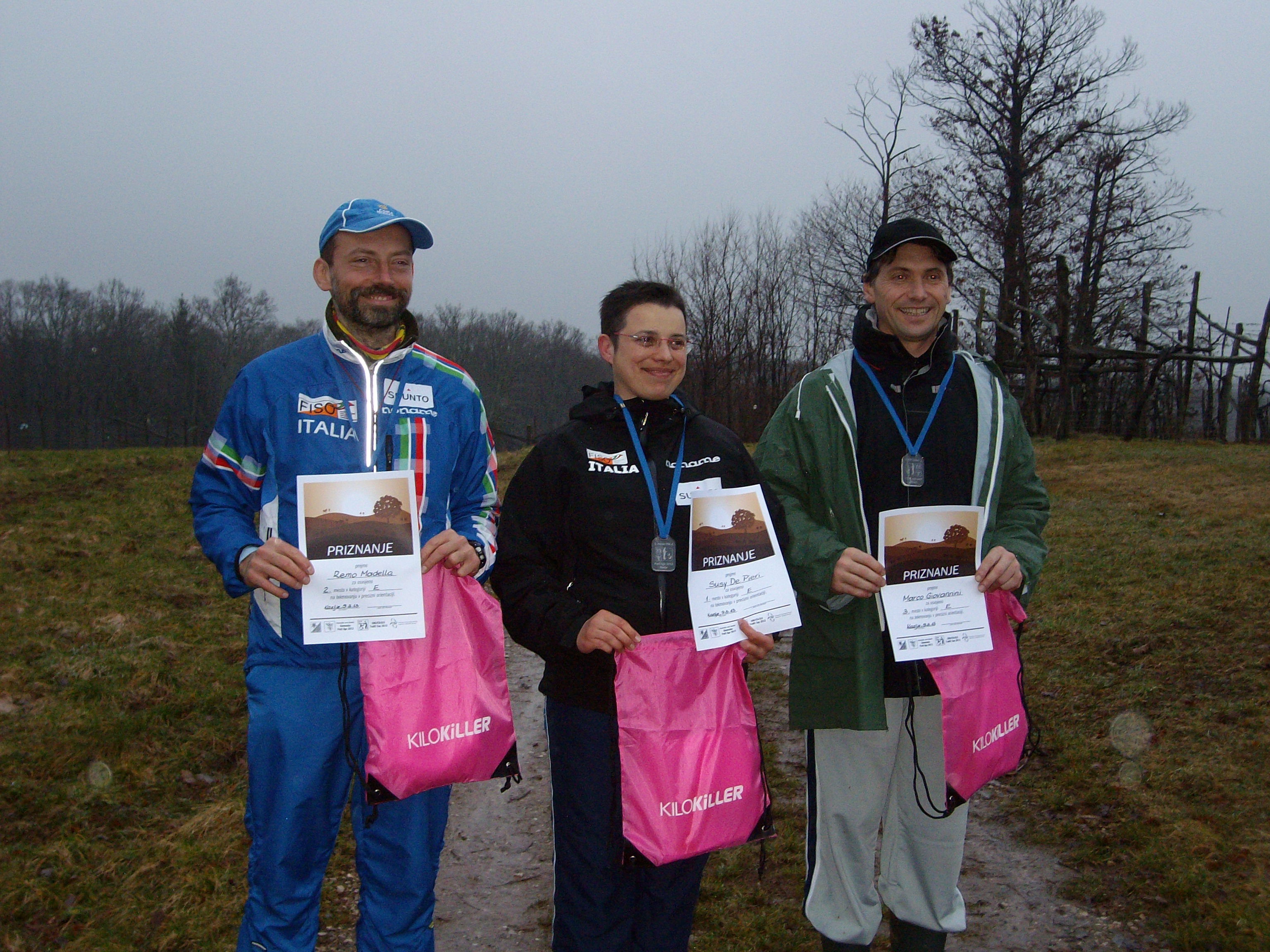
Pubblicato il 07/03/2013 12:37:16 | Webmaster
During last day, a lot of competitors have tried to take the leadership but Finland has placed three competiors on the podium. We have 9 Finnish competitors in the top 12! The first one out of Finland is Emil from Slovenia and the Italian couple Guido and Remox were able to enter in the top ten.
I can say the most part of best trailorienteers have played and this is a big stimulus, for me, to continue this project. I'm receiving some advises to improve the game's option and I'll try to do my best. Now, the trailO's season is starting and I wish to everybody a lot of fun.
I hope to organize a new trophy before the WTOC.
Pubblicato il 06/03/2013 08:26:23 | Webmaster
Nobody was able to take the leadership; the news is the number of competitor is over my target of 50 people. Again, I saw many the Finnish competiors (a silver medal at WTOC 2012) and finally, the Latvian have discovered this game reading the message on their national website (I thank Janis). Today is the last day: I've not decided a deadline and I think to stop the game tomorrow, early in the morning.
...Pubblicato il 05/03/2013 08:31:25 | Webmaster
Saku is the name of the day: he was very close to take the first place. He's another Finnish orienteer and I can write that Finland is the country most active on this website during these days. I'm very happy because I saw some people from Japan to play the training games: I hope to see their nicknames in the competition. My target of 50 competitors is very close and I can say the match was very "high level" because the competitors are the best for each Nation. Among the registrations I see other excellent trailorienteers but they are waiting for last minute to play.
...Pubblicato il 04/03/2013 08:47:18 | Webmaster
Sunday doesn't bring new leader but the news is the name of a player: Tero! Have you ever listened to this nickname? He's the true Tero... His performance don't sound very well but he has played using an ipod! Finland has tried to add another leader but Marko has lost the podium after last game. We're wainting for Ivo's performance and other good tempOrienteer.
...Pubblicato il 03/03/2013 08:35:42 | Webmaster
Sweden has played one of his aces: Marit Wiksell. She was the fastest to answer but she hasn't found the right feeling with some controls; 13 errors are too much to take the victory. Next days, I hope to engage Stig, Guido or somebody else of the top trailorienteers. In the night, from Finland, Lion has taken the third place: he's not a trailorienteer but he's an excellent orienteer! he spent the right quantity of time to study the tasks and he made 7 mistakes. Now, the podium is all for Finland....
...Pubblicato il 02/03/2013 09:56:37 | Webmaster
The news of this day is the result of MartinJu: he has had some problems with the software and the controls... it wasn't the best performance for him but he wrote to me "I want the second edition because I want to score better.."; I think he has underestimated the trophy and his training wasn't sufficient to beat the Finnish guys. I noted the performance of krautrock: in the last four game he's scored like Antti but he was terrible trailorienteer during the first seven games...
...Pubblicato il 01/03/2013 08:40:17 | Webmaster
Day 4 is been an important day: Finland has played its aces! Lauri and Antti have showed their class; Lauri was faster than Antti but he made one mistake more than him (6 vs 7). Lauri had an awesome score untill game 10 and he has preserved his first place for 7 seconds despite last one horrible score. Behind this excellent couple, there is Remox: he tried to answer very fast but some controls weren't in feeling with him. Now, the podium is very important but we wainting for others first rate trailorienteers....
Pubblicato il 28/02/2013 09:04:31 | Webmaster
No news about the leadership after third day; the only one entry in top five is the result of JanaK. Now, only one control remains without right answer! The most part of the players come from Czech R.
...Pubblicato il 27/02/2013 08:51:25 | Webmaster
After two days, we have a new podium: Susy from Italy, Christian from Sweden and Pakuo from Chech. 23 are the right controls for Susy and 22 for L.Tecka; three are the controls too difficult (all the competitors have given the wrong answer) while Christian was the only one to answer right to another very difficult task. I'm waiting for other "great" competiors to understand the real difficult of my taskes.
...Pubblicato il 26/02/2013 21:15:45 | Webmaster
Hi friends, I ask you a favour: during past weeks many people were here to visit the game and the site. I haven't their emails and a lot of them arrived here because some sites and blogs (expecially Spain, Norway and Hungary) have linked this site. Now, you're playing the TempO Trophy and his finish will be on 6th March; I regret if somebody of them will arrive here after that date. So, I hope if you have emails or blogs you can advise these trailO's friends. Thanks
...Pubblicato il 26/02/2013 06:42:56 | Webmaster
Many registrations but few results; after first day I saw 5 competitors at the finish and more than 10 at the start. I am very interesting about some controls: are they too difficult? the best result is the score of Kreker he's a very good competitor) but only 19 controls are right! In the next days, I hope to see other good player to understand if my controls are too much hard.
...Pubblicato il 25/02/2013 13:15:24 | Webmaster
Hi, somebody have sent a email to ask me: "Is possible to score 160 points?!" I say you that Rusky is my nickname and I have used it to test the game.... don't worry about that record.
...Pubblicato il 24/02/2013 20:25:08 | Webmaster
Hi everybody, now you can play the TempO Trophy; pay attention when you register your dates. I suggest you to open "HELP: follow the steps" and read the red types near or inside the red circles. I hope you are honest and you play to enjoy yourselves...
...Pubblicato il 20/02/2013 16:48:04 | Webmaster
TrailO's friends, It's official new: on Monday 25th, it'll start the Trophy! I have prepared a link (help) where you can see the steps of the game. My friends are learning tempO discipline to testing these games...
...Pubblicato il 19/02/2013 19:59:55 | Webmaster
Everything is ready but I'm working on the last little details... I think next week you can start to play with the games! Please, contact your friends and invite them to play the Trophy! Stay tuned.
...Pubblicato il 10/02/2013 10:43:55 | Webmaster
Important news about the future of trailO; in the last meeting (January 2013), the Board has discussed some ideas about tempO formula, Pre-O improvements and other themes. Click on link to find the note....
...
Pubblicato il 02/02/2013 19:57:42 | Webmaster
Hi everybody, I'm working about the TempO Trophy; I have ready eleven games and in next weeks I want to organize the match. My idea is to register all the competitors with a registration online; the competion will be open for a week or more (I'll decide it later). You'll have a password and you'll play during this time your games; after every game, you can't see the solutions but only your score. At the end of the competition I'll post all the games on line for everybody; if you have others ideas please contact me to say your opinion.
...Pubblicato il 27/01/2013 19:59:54 | Webmaster
Today, many Italian competitors will remember this manifestation: 40 controls scattered in 8 stations around the town near Venice! TempO is a discipline very exciting but today the difficult of some controls have increased the stress of the match. Remo Madella, when arrived at the finish, was confident his performance had 4/5 errors; when he saw the solutions, he wasn't happy because 10 errors were too much to win the competition. Elvio Cereser was very happy when he saw the solution because he had only 6 mistakes! But TempO is not PreO: Remo has won the competition, Elvio was only eleventh.... As you have understood, today everybody (except Elvio) have more than 10 errors but the penality (30" for one error) has rewarded who has spent few seconds to answer. The jury has deleted one control (right place but wrong control description) and has reject the protest about station 5 (some people have invaded the terrain during the competition and one competitor was impaired); curiosly, Jasminka was member of jury and if the station number 5 was deleted she would have been the winner. Behind Remo, the second place is for Kreso Kerestes, third place Jasminka Perkovic, fourth place Daniele Danieli, fifth place Tisljar.... if you think the name of Ivo you are wrong! his name is Antun and he's the future for Croatia team! Click on "Link" to see the map...
Pubblicato il 26/01/2013 18:32:01 | Webmaster
Today, in a sunny and not too much cold day, the Italy cup started in Martellago. There were 30 people to compete for the victory; despite many good trailorienters have competed only Remo Madella was able to make a winning strip of answers. Behind him, the only one with one mistake, the Italian champion 2012 (ex aequo) Michele Cera; two mistakes were for Dalibor Perkovic (3°), Dario Citterico (4°) and Marco Giovannini (5°). Bad news for Elvio Cereser (10°), with two mistakes in time controls, Alberto Grilli (13°) and Danieli Daniele (19°); good positions for Ivo Tsljar (6°) and Kreso Kerestes (7°). Renato Bettin, the planner, has submitted 21 controls scattered in a large park with two small lakes and rough vegetation; many controls were very far from the point of view and others were not easy to identify. I can tell it was a good competition with only one control unclear. Tomorrow next meeting: tempo formula in Marcon!
| Position | Competitor | Country | Points | Time |
|---|---|---|---|---|
| 1 | Madella Remo | ITA | 21 | 35 |
| 2 | Cera Michele | ITA | 20 | 28 |
| 3 | Perkovic Dalibor | CRO | 19 | 23 |
| 4 | Citterico Dario | ITA | 19 | 29 |
| 5 | Giovannini Marco | SLO | 19 | 85 |
| 6 | Tisljar Ivo | CRO | 18 | 26 |
| 7 | Kerestes Kreso | SLO | 18 | 71 |
| 8 | Lo Grasso Antonino | ITA | 18 | 92 |
| 9 | Padoan Paolo | ITA | 18 | 94 |
| 10 | Cereser Elvio | ITA | 18 | 161 |
| 11 | Perkovic Jasminka | CRO | 17 | 16 |
| 12 | Grilli Alberto | ITA | 17 | 25 |
| 13 | Pfister Valerio | ITA | 17 | 27 |
| 14 | Michelotti Giuliano | ITA | 17 | 48 |
| 15 | De Pieri Susy | ITA | 17 | 71 |
Pubblicato il 24/01/2013 21:43:01 | Webmaster
This weekend, two competitions are in Italy: on Saturday, in Martellago, the first round of Italy cup; on Sunday, the first round of tempO trophy. There are all the best trailorienteers except Guido Michelotti and Stefano Galletti. From Croatia and Slovenja there will be at the competition the most of the best exponents. Not offical news about Cro-Ita-Slo trophy but it seems that this round will be the first round.
...Pubblicato il 19/01/2013 19:34:44 | Webmaster
Today, Italian Federation has a new President and new board. Which will be the future of Italian TrailO ? I don't know because in the programs of candidates about trailo there was only one sentence: "to involve CIP (italian commitee paralimpyc) in trailO discipline...." No words about national team, programs, trainings or something else. I believe nobody is interested in trailO: only the current competitors are thinking about the future, the remainder of movement will continue to think: "TrailO is discipline of low class"
...Pubblicato il 17/01/2013 10:05:25 | Webmaster
New Year = new life !
www.trailo.it is working about a new look and to add some little trasformations.
Now, you can find the TempO Game and the International result database (perhaps it could have some mistakes).
Only on 15th January, FISO has publicized the Italian schedule; Remo's web site (http://www.remmaps.it/trailo/) has updated the 2013 trailO's manifestations.
On the blog of Joaquim Margarido you can find my interview; here, you can find the news about the second part of "treilonline" competition.
The first round of Italy cup will be in Martellago on 26th January.
Pubblicato il 18/11/2012 16:58:35 | Webmaster
Remo Madella has won the Croatia - Italy - Slovenja Trophy; he collected six results of eleven stages and he surpassed the three athletes who were in the podium. Second place to Renato Bettin, third to Elvio Cereser, fourth to Mateja Kerestes, fifth to Susy De Pieri and sixth to Marco Giovannini: all them have more than 500 points.
The last two competitions took place in Galgovo near Zagreb (Croatia); both stages were in the same terrain and map and many controls were very close. I could say the right name of these competitions is " the trailO of the counting steps" because a lot of controls could be find only with this tecnical method; the map was a long stripe of white wood with micro details and few objects recognizable.
The best, on Saturday were Madella, K. Kerestes, Michelotti Jr., Bettin, Horjan (but he didn't answer two controls); on Sunday the best were Michelotti Jr, I. Bertol, S. Zuzic, R. Bettin, M.Beltramo.
It's very strange to see some competitors in different positions despite the rounds were very similar!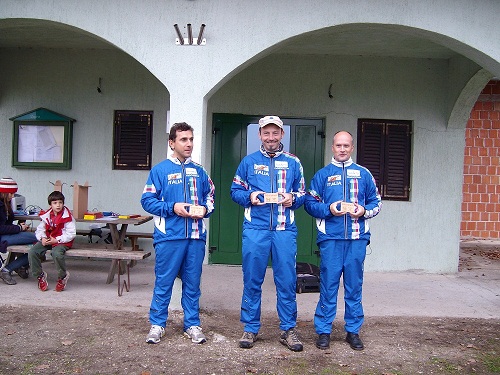
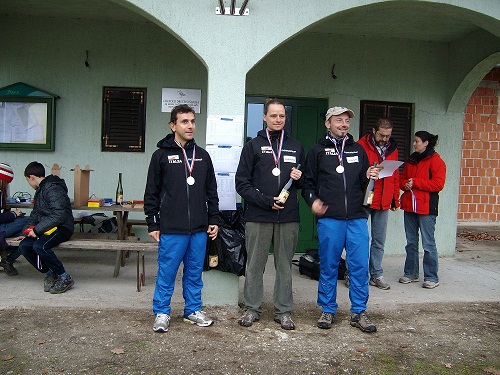
Pubblicato il 11/11/2012 08:17:21 | Webmaster
Finally, after some postponed dates, Ok Orion has organized Feud cup or Cro-Ita-Slo rounds on 17th and 18th November; the location is Galgovo near Zagreb (Croatia).
Here, you can find last news; the situation about Cro-Ita-Slo Trophy is not definite because all the possible winners are entered the competition.
Despite the long distance from Italy, the best Italian trail-orienteers will be in Croatia.
Here, the registration!
Pubblicato il 26/10/2012 22:34:48 | Webmaster